


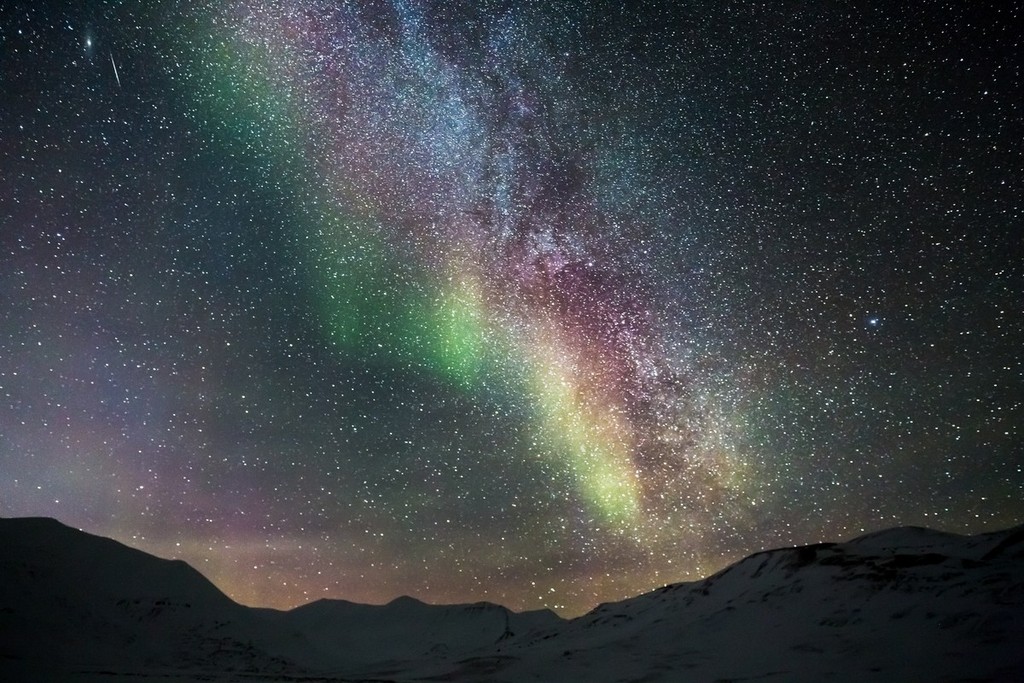
Under certain conditions, the Northern Lights can be seen much farther south, and Romania is among the countries where the aurora can occasionally be observed during powerful geomagnetic storms.
In recent years, Romania's night skies have provided several opportunities to witness this rare spectacle, making the aurora borealis one of the most remarkable natural phenomena that can sometimes be seen from the country.
What exactly is the Northern Lights?
The aurora borealis is a natural light phenomenon that occurs in the upper atmosphere. It is produced when energetic particles originating from solar activity interact with Earth's magnetic field and the gases in the upper atmosphere.
The Sun constantly releases a stream of electrically charged particles known as the solar wind. During powerful solar eruptions, coronal mass ejections can also occur, sending large quantities of plasma into space.
When these particles reach the vicinity of Earth, they interact with the magnetosphere. During a strong geomagnetic storm, the auroral zone can expand considerably toward lower latitudes, making the phenomenon visible in regions where it would normally not occur.
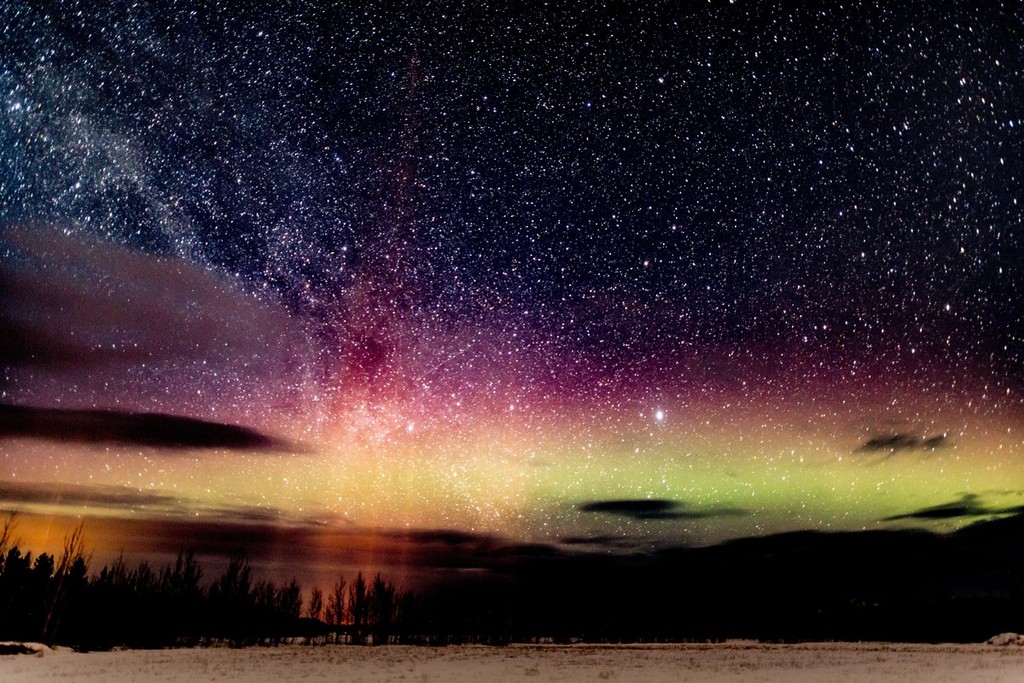
The aurora does not have a single color. It can appear green, red, violet, pink or in combinations of these colors, depending on the altitude and the atmospheric gases involved. The reddish colors sometimes observed from Romania are therefore entirely consistent with the natural phenomenon.
Why can the Northern Lights be seen from Romania?
Romania is located considerably farther south than the regions where auroras are normally observed. Under normal conditions, the auroral oval is concentrated around the polar regions.
During powerful geomagnetic storms, however, the auroral oval expands toward lower latitudes. The Kp index, which ranges from 0 to 9, is one of the indicators used to assess geomagnetic activity. The higher the value, the farther south the aurora can potentially become visible.
At very high levels of geomagnetic activity, the aurora can therefore appear in areas where it is normally extremely unusual. Romania falls into this category.
In other words, seeing the Northern Lights from Romania does not mean that the country has somehow become close to the North Pole. It means that an exceptionally strong geomagnetic storm has temporarily pushed the auroral zone much farther south.
Romania has already seen the Northern Lights
This is not merely a theoretical possibility. The aurora borealis has been documented several times from Romania in recent years.
One of the most spectacular recent episodes occurred during the night of May 10–11, 2024. The Northern Lights were observed from several parts of Romania, with reddish shades being particularly noticeable. The event occurred during an exceptionally strong geomagnetic storm, at a time of high solar activity.
The Astronomical Observatory "Amiral Vasile Urseanu" in Bucharest also published images captured by an all-sky camera, documenting the aurora over Romania.
The May 2024 event was particularly impressive because the aurora became visible even without sophisticated astronomical equipment, especially from locations with dark skies and an unobstructed view toward the north.
October 2024 brought another spectacular display
Another significant episode occurred in October 2024, when the Northern Lights were observed from several parts of Romania, including areas of Sălaj County.
Images taken by local residents showed the night sky illuminated by characteristic reddish and purple tones.
The event was associated with a geomagnetic storm caused by a coronal mass ejection. Such events can send large quantities of charged particles toward Earth and cause the auroral oval to expand toward lower latitudes.
Romanian astronomical sources have also recorded auroral events visible from the country on November 5, 2023, May 10, 2024, October 10, 2024 and January 1, 2025, highlighting how unusual the phenomenon is at Romanian latitudes.
Where can the Northern Lights be seen from Romania?
There is no single location in Romania where the Northern Lights can be seen regularly. Unlike northern destinations, where aurora watching can be incorporated into a planned holiday, viewing the phenomenon from Romania depends almost entirely on the occurrence of a sufficiently strong geomagnetic storm.
When conditions are favorable, the best locations are generally:
rural areas far from major cities;
places with very little light pollution;
hills and mountain areas with an unobstructed northern horizon;
locations away from buildings, trees and other obstacles that block the view toward the north.
During the May 2024 event, the aurora was photographed from numerous locations across Romania, demonstrating that during a sufficiently powerful geomagnetic storm the phenomenon is not restricted to one particular part of the country.
Why cities are not ideal
In theory, the aurora can be observed from near a city. In practice, light pollution can make the difference between a barely visible phenomenon and a spectacular display.
Artificial light from streets, buildings, advertising and vehicles reduces the contrast between the aurora and the night sky. For this reason, when a strong geomagnetic storm is forecast, moving away from urban areas can significantly improve the chances of seeing the lights.
Clear weather is equally important. Even if geomagnetic activity is extremely high, clouds can completely prevent the phenomenon from being observed.
Which direction should you look?
From Romania, when the aurora expands far enough south, observers should primarily look toward the north.
The phenomenon may initially appear close to the horizon as a faint reddish or greenish glow. During exceptionally strong storms, the auroral structures can become much more prominent and may cover a significant portion of the northern sky.
For an observer in Romania, therefore, a location with an unobstructed view toward the northern horizon is particularly valuable.
Can it be seen with the naked eye?
Yes, although there can be a significant difference between what the human eye sees and what a camera records.
During an intense event such as the one in May 2024, the aurora was visible directly from Romania.
When the activity is weaker, however, a camera can capture colors and structures that are difficult to perceive with the naked eye. A camera sensor can collect more light during a longer exposure, making the aurora appear considerably more colorful or intense in photographs.
This is important when looking at images posted online: a highly saturated photograph does not necessarily represent exactly what the observer saw with the naked eye.
When is the best time to see it?
The aurora can appear at different times during the night, and its intensity can change rapidly.
The hours around midnight are generally considered favorable for aurora observation, although during strong geomagnetic activity the viewing window can be considerably wider.
For Romania, however, there is no simple rule such as "the aurora appears at a specific hour." Geomagnetic activity can change quickly, and the phenomenon may appear in several separate episodes during the same night.
For this reason, when a geomagnetic storm is forecast, monitoring real-time space-weather conditions is more useful than relying on a single predetermined time.
Are spring and autumn favorable seasons?
The periods around the spring and autumn equinoxes are generally considered favorable for geomagnetic activity and, consequently, for auroral displays.
However, this does not mean that the Northern Lights will appear in Romania every spring or autumn. A rare combination of factors is still required: strong solar activity, a coronal mass ejection directed toward Earth, sufficiently intense geomagnetic activity, darkness and clear skies.
Solar activity is crucial
The appearance of the Northern Lights is closely linked to solar activity.
The Sun follows an approximately 11-year cycle of activity. Around the solar maximum, the probability of powerful solar eruptions and space-weather events capable of producing strong geomagnetic storms increases.
This helps explain why Romania has experienced several notable auroral displays in recent years. The May 2024 event, for example, occurred during an exceptionally powerful geomagnetic storm that allowed the aurora to become visible at unusually low latitudes.
Are the Northern Lights dangerous?
The aurora itself is not dangerous to people observing it from the ground.
However, the geomagnetic storms that produce exceptionally strong auroras can affect certain technological systems. Strong space-weather events can interfere with power grids, satellites, radio communications and navigation systems such as GPS.
For tourists, photographers and other observers on the ground, watching the aurora is therefore a safe activity. The phenomenon should not be confused with harmful radiation reaching the Earth's surface.
Why is the aurora so special in Romania?
In northern countries, the Northern Lights can be a relatively common seasonal phenomenon. In Romania, the situation is completely different.
Here, an auroral display is an exceptional event. It cannot be guaranteed simply by booking accommodation in a particular location or choosing a certain month.
A sufficiently powerful geomagnetic storm must occur for the auroral oval to expand far enough south to reach Romanian latitudes.
That rarity is precisely what makes the Northern Lights so special for Romanian observers.
How can you follow a possible aurora?
Anyone interested in seeing the phenomenon should follow space-weather forecasts and pay particular attention to:
the Kp index;
geomagnetic storm alerts;
solar activity;
coronal mass ejections;
European aurora forecasts;
local weather conditions;
light-pollution levels.
The Kp index is one of the most useful indicators for the general public, but it should not be interpreted as a guarantee. The relationship between the Kp value and the southernmost extent of the aurora is approximate, and individual geomagnetic storms can behave differently.
The Northern Lights from Romania: rare, but real
The idea that the Northern Lights can only be seen in Scandinavia is incorrect. The aurora normally occurs at high latitudes, but during major geomagnetic storms it can become visible much farther south.
Romania has already provided several spectacular examples. Events recorded in November 2023, May 2024, October 2024 and January 2025 demonstrate that, under exceptional conditions, the Northern Lights can illuminate the Romanian night sky.
For those hoping to witness the phenomenon, the essential ingredients are patience, a dark location, an unobstructed northern horizon, clear skies and, above all, a sufficiently powerful geomagnetic storm.
The Northern Lights are not a phenomenon that Romania can offer every season. That is precisely why, when the aurora appears above the country, it becomes one of the rarest and most spectacular natural phenomena visible from Romanian soil.




 International editions: