


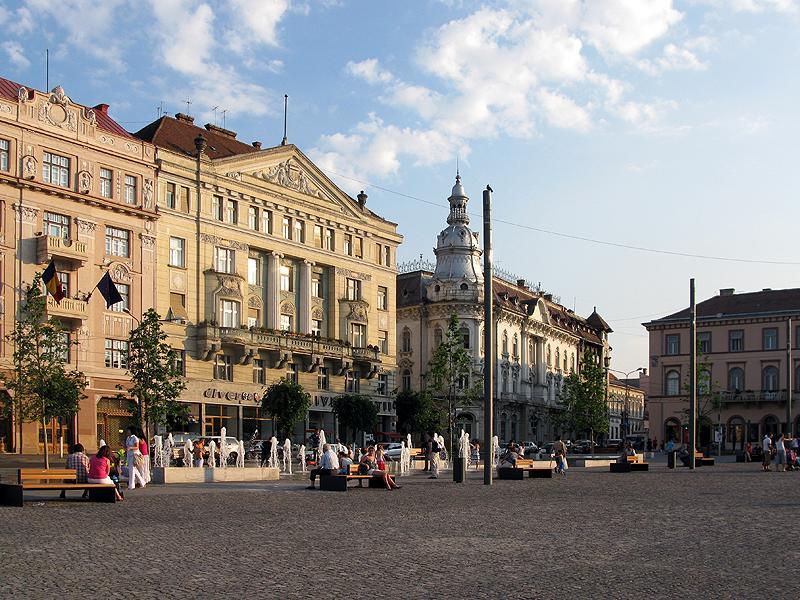
Located in the historic centre of Cluj-Napoca, Union Square (Piața Unirii) remains one of the city's most recognisable landmarks and an important symbol of Transylvania's architectural and cultural heritage. In 2026, the square continues to attract visitors from Romania and abroad, offering a fascinating journey through the city's medieval past and its contemporary urban life.
Surrounded by historic buildings, elegant façades, cafés and cultural attractions, Union Square is much more than a tourist destination. It is a meeting place for residents, a setting for public events and one of the most representative spaces in Cluj-Napoca.
A historic square with centuries of stories
The history of Union Square is closely connected to the development of medieval Cluj, historically known as Kolozsvár in Hungarian and Klausenburg in German. For centuries, the square has served as an important commercial, administrative and social centre, witnessing major transformations in the city's history.
Its name has changed several times, reflecting the political and historical circumstances of different periods. Known as the Great Square and later as the Main Square, it was also associated with King Matthias Corvinus, one of the most prominent historical figures connected to Cluj. Following Transylvania's union with Romania in 1918, the square became known as Union Square. During the communist period, it was called Liberty Square, before regaining its present name after 1989.
Today, the square preserves its historical character while remaining an active part of the city's everyday life.
St. Michael's Church, a masterpiece of Gothic architecture
One of the most impressive monuments in Union Square is St. Michael's Church, a magnificent example of Gothic architecture in Romania. Construction began in the 14th century, and the church remains one of the most important medieval religious buildings in Transylvania.
Its imposing neo-Gothic tower, added in the 19th century, dominates the surrounding skyline and makes the church one of the most recognisable architectural landmarks in Cluj-Napoca.
Visitors can admire the church's remarkable architectural details, its spacious interior and the atmosphere of a monument that has witnessed centuries of religious, cultural and political history.
The church is also closely associated with important moments in Transylvania's past, reflecting the multicultural heritage of a city shaped by Romanian, Hungarian, German and other communities.
Matthias Corvinus and one of the city's most famous monuments
In front of St. Michael's Church stands the monumental sculptural ensemble dedicated to Matthias Corvinus, King of Hungary from 1458 to 1490.
Born in Cluj in 1443, Matthias Corvinus was the son of John Hunyadi, known in Romanian history as Iancu de Hunedoara, a prominent military commander who played a major role in the struggle against Ottoman expansion.
The monument, created by sculptor János Fadrusz and inaugurated in 1902, depicts the king on horseback, surrounded by four important military figures. It is considered one of the city's most significant works of public art and remains a popular attraction for tourists and photographers.
A visit to Union Square also offers an opportunity to discover the birthplace of Matthias Corvinus, located within walking distance of the square, in the historic centre of Cluj-Napoca.
Historic palaces and architectural treasures
Union Square is surrounded by buildings that reflect the city's rich architectural heritage.
Among the most remarkable is Bánffy Palace, an outstanding example of Baroque architecture in Transylvania. Built in the 18th century, the palace now houses the Cluj-Napoca Art Museum, which preserves important collections of Romanian and European art.
Another distinctive feature is the pair of symmetrical buildings marking the entrance to Iuliu Maniu Street, a picturesque urban composition often admired by visitors.
The former Continental Hotel, historically known as Hotel New York, is another emblematic building overlooking the square. Its architecture recalls the elegance of Cluj's late 19th-century urban development.
Archaeological remains from the Roman period also provide a connection to the ancient settlement of Napoca, demonstrating that the history of this location extends far beyond the medieval city.
Together, these landmarks create an architectural landscape in which Gothic, Baroque, Renaissance-influenced and later historicist styles coexist.
Union Square in 2026: where history meets contemporary life
Although its historic monuments remain its main attractions, Union Square is also one of the liveliest public spaces in Cluj-Napoca.
Throughout the year, the square serves as a setting for cultural activities, public celebrations, festivals and seasonal events. Its central location makes it a natural meeting point for residents, students and tourists exploring the city.
Cluj-Napoca is widely recognised as an important university and cultural centre, and the atmosphere of Union Square reflects this identity. Historic architecture stands alongside modern cafés, restaurants and public spaces, creating an environment where tradition and contemporary life meet.
The square is particularly attractive for walking and photography, with its open spaces offering impressive views of St. Michael's Church, the Matthias Corvinus monument and the surrounding historic façades.
What visitors can discover nearby
Union Square is an excellent starting point for exploring the main attractions of Cluj-Napoca.
Within walking distance, visitors can discover the birthplace of Matthias Corvinus, the Franciscan Church and Museum Square, as well as the historic streets of the old town.
Other nearby attractions include the Transylvanian Museum of Ethnography, the National Museum of Transylvanian History and the city's Central Park, a popular green space for relaxation.
The Alexandru Borza Botanical Garden, one of Romania's best-known botanical gardens, is another destination worth including in a visit to Cluj-Napoca.
Thanks to its central position, Union Square allows travellers to experience many of the city's most important historical and cultural landmarks without travelling long distances.
A timeless symbol of Cluj-Napoca
In 2026, Union Square continues to represent the historical and cultural identity of Cluj-Napoca. Its medieval origins, remarkable monuments and lively atmosphere make it one of the most memorable destinations in Transylvania.
For visitors discovering the city for the first time, the square offers an introduction to centuries of history. For those returning to Cluj-Napoca, it remains a familiar place where the past and present meet.
More than a landmark, Union Square is a living expression of the city's heritage, a place where every building tells a story and every visit offers a new perspective on the heart of Transylvania.




 International editions: