


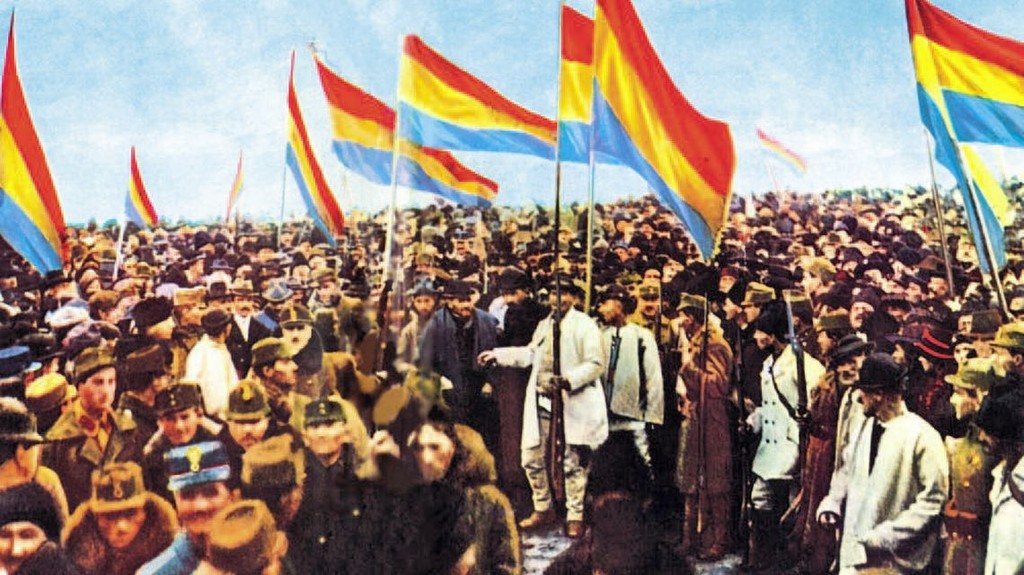
Every year, on December 1, Romania celebrates its National Day, a date of profound significance for the country's history and national identity. On December 1, 1918, in Alba Iulia, representatives of Romanians from Transylvania, Banat, Crișana, and Maramureș adopted the resolution to unite with Romania, marking a decisive moment in the formation of the modern Romanian nation-state.
The event represented the culmination of a historical process that had unfolded over several generations, against the backdrop of the political and territorial transformations that reshaped Europe at the end of the First World War. The Great Union of 1918 contributed to the formation of Greater Romania and became one of the defining milestones in the country's modern history.
The union of 1918 was not the result of a single event but the outcome of a complex historical evolution. An essential milestone occurred in 1859, when Moldavia and Wallachia united under the leadership of Alexandru Ioan Cuza, laying the foundations of the modern Romanian state. Independence, achieved following the War of 1877–1878, and the proclamation of the Kingdom of Romania in 1881 subsequently strengthened the country's position in Europe.
At the end of the First World War, the collapse of the Austro-Hungarian Empire and political changes in Eastern Europe created the conditions for the territorial reorganization of the region. In this context, representatives of several historical provinces adopted decisions to unite with Romania.
On March 27, 1918, the Sfatul Țării (Council of the Country) in Chișinău voted for the union of Bessarabia with Romania. On November 28, the General Congress of Bukovina decided to unite the province with the Kingdom of Romania. The process culminated on December 1 with the adoption of the Resolution of Alba Iulia.
On December 1, 1918, Alba Iulia became the center of an event of exceptional historical importance. Delegates and numerous participants arrived from different parts of Transylvania and neighboring territories to attend the Great National Assembly.
The official proceedings took place in what is now known as the Union Hall, where 1,228 delegates gathered. The resolution calling for union was presented by Vasile Goldiș, one of the leading figures of the Romanian national movement, and was adopted unanimously.
The document proclaimed the union with Romania and outlined principles concerning the democratic organization of the new state, provisional autonomy for the united territories, religious freedom, the rights of the different nationalities living within its borders, and citizens' participation in political life.
The decision taken in Alba Iulia was followed by legislative and administrative measures aimed at integrating the new provinces. International recognition of Romania's new borders was subsequently established through the peace treaties concluded after the First World War.
The Great Union represented a fundamental transformation in the development of the Romanian state. Through the events of 1918, Romania considerably expanded its territory and population, bringing together regions with different historical, cultural, and administrative traditions.
The integration of these provinces required a complex process of legislative, institutional, and economic harmonization. In the following years, the Romanian state underwent important reforms, including the adoption of the Constitution of 1923, which helped establish the political and legal framework of Greater Romania.
Beyond its territorial dimension, the Great Union acquired profound symbolic significance for Romanian national identity, becoming associated with the aspirations for unity and self-determination expressed by Romanians during that period.
The events of 1918 must also be understood in the context of the ethnic and cultural diversity of the reunited regions. The enlarged state included Romanian, Hungarian, German, Jewish, and other communities, making coexistence and the protection of minority rights important aspects of Romania's development during the interwar period.
December 1 officially became Romania's National Day in 1990, following the fall of the communist regime, through Law No. 10 of July 31.
Previously, the country had celebrated its national holiday on other historically significant dates. During the monarchy, May 10 was associated with the beginning of King Carol I's reign, Romania's independence, and the proclamation of the Kingdom of Romania. Under the communist regime, the national holiday was celebrated on August 23, a date linked to the events of 1944 and Romania's change of allegiance during the Second World War.
The choice of December 1 after the Romanian Revolution of 1989 placed the historic moment of the Great Union at the center of the country's national celebrations.
Today, Romania's National Day is marked by official ceremonies, military parades, wreath-laying ceremonies, cultural events, and activities dedicated to Romanian history and traditions. The occasion is celebrated both throughout the country and by Romanian communities living abroad.
One hundred and eight years after the Great Union, the events of 1918 continue to occupy a central place in the collective memory of Romanians. Alba Iulia remains one of the most important symbolic locations in the country's history, while the Union Hall and other monuments associated with the event preserve the legacy of a decisive period in Romania's development.
December 1 represents more than the commemoration of a historic decision. It also offers an opportunity to reflect on the evolution of the Romanian state, its cultural heritage, and the values that contribute to social cohesion.
The Great Union therefore remains a fundamental landmark in Romania's history, and its anniversary provides each generation with an opportunity to rediscover the events, personalities, and transformations that helped shape modern Romania.





 International editions: