


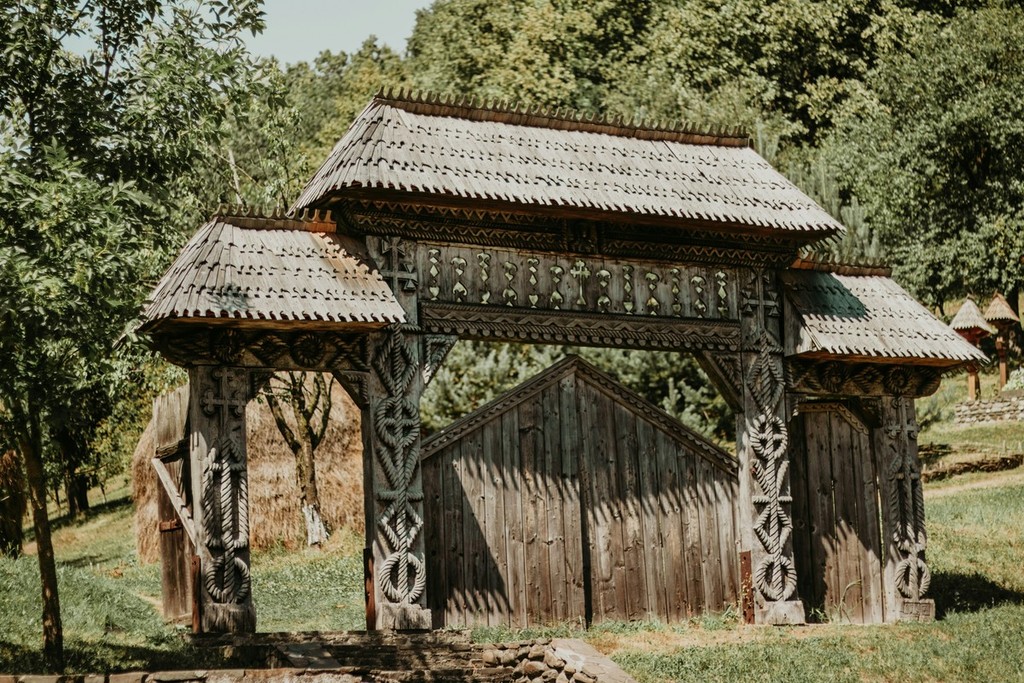
Houses, churches, farm buildings and, above all, the monumental carved wooden gates preserve the image of a rural culture in which craftsmanship and everyday life were closely connected.
The traditional Maramureș gate was not simply a practical feature of a household. Its size, structure and carved decoration turned it into a distinctive landmark of the village. Traditionally made mainly from wood, the gate could consist of massive posts, an upper beam and a smaller entrance for pedestrians.
One of its best-known characteristics is the richness of its wood carving. Local craftsmen decorated the posts and beams with geometric, vegetal and symbolic motifs, transforming a functional structure into an expression of traditional folk art.
The patterns found on traditional gates vary from one area to another and from one craftsman to another. Some motifs are inspired by the natural world, while others are geometric or belong to the traditional ornamental repertoire. These decorative elements contribute to the individual character of each gate.
In Romanian traditional culture, certain carved motifs have over time been associated with ideas such as protection, continuity, fertility or the relationship between people and nature. Their interpretation should nevertheless be considered within the context of each local community and tradition, since the same motif may have different meanings or explanations.
The gate also had an important social function. In the traditional village, it marked the transition between the public space of the road and the private space of the household. It was therefore more than a physical boundary: it was also an element that expressed the identity and character of the home.
In the past, building a monumental wooden gate required considerable work and specialised knowledge. Selecting the timber, preparing the material, assembling the structure and carving the decorative elements all required experience. These techniques were passed down within communities and from one generation to the next.
Maramureș is also renowned for its tradition of wooden architecture, and the gates form part of the same material culture that has given the region some of the most recognisable examples of rural architecture in Romania. Wooden churches, traditional houses and carved gates together form a heritage shaped by the use of wood as a fundamental building material.
One of the most distinctive features of the Maramureș gates is their monumental character. In some villages, traditional gates can become elaborate architectural structures, with tall posts and intricate carvings. They provide an insight into the importance that the household and property held within the organisation of traditional village life.
Wood carving was not limited to gates. The same craftsmanship could be found in household objects, furniture, tools and architectural elements. Wood was an accessible and versatile material, while the skills of local craftsmen allowed it to be transformed into both objects needed for everyday life and works of artistic expression.
Today, traditional gates can still be found in many villages across Maramureș. Some households have preserved old gates, while others continue the tradition through new structures inspired by local models. Protecting these elements is important for maintaining the architectural and cultural character of Maramureș villages.
For visitors, a journey through Maramureș can therefore also become an exploration of the region’s woodcarving tradition. Beyond the beauty of the carved details, each gate tells something about the way people built their homes, organised their households and lived within a landscape where wood was one of the most important natural materials.
The Maramureș gates remain one of the most recognisable images of the region. They bring together function and decoration, tradition and local identity, transforming the entrance to a household into a distinctive expression of Romanian folk art.
In the carved wood of these gates, it is therefore possible to discover not only patterns and ornaments, but also the memory of a craft passed down through generations. They remain tangible witnesses to a rural world in which architecture, nature and community life formed a closely connected whole.





 International editions: