


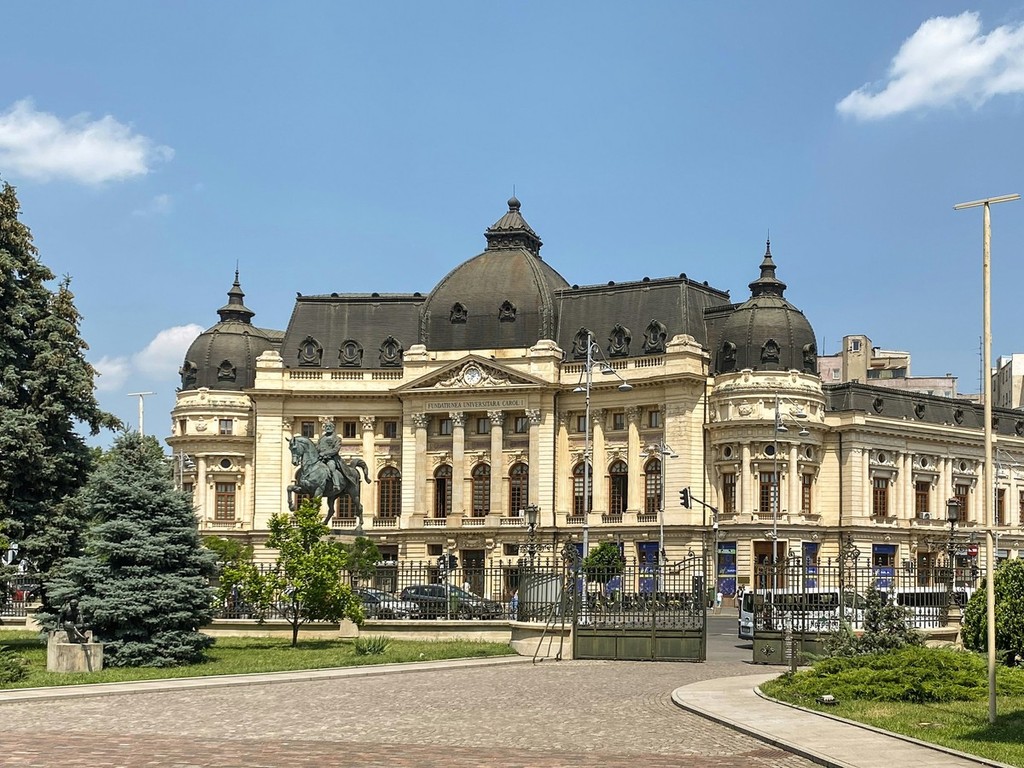
To understand Bucharest's urban development, we can look at the city as a succession of areas shaped during different historical periods, starting from the heart of the capital, around the Royal Palace and University Square, and gradually extending towards the outer districts and surrounding communities.
The first area is Bucharest's historic centre, particularly the Old Town and its neighbouring districts. Here, part of the architectural charm of old Bucharest, once nicknamed "Little Paris", can still be experienced. Historic buildings, elegant palaces, distinctive streets and public gardens recall a time when the Romanian capital was strongly influenced by Western European architecture and culture. Among its most representative landmarks are the Romanian Athenaeum, the Royal Palace, Calea Victoriei and the historic buildings surrounding them.


Another important stage in the city's development took place during the communist period, when Bucharest experienced rapid urban expansion. Extensive residential neighbourhoods were built, characterised by apartment blocks, wide boulevards and relatively uniform architectural designs. This transformation also resulted in the demolition of historic buildings and entire sections of the city. Nevertheless, many neighbourhoods developed during that period also include green spaces, parks and recreational areas that remain important to residents today.
Today, Bucharest continues to expand both within its administrative boundaries and beyond them. The northern part of the capital, particularly the Pipera, Băneasa and Aviației areas, has developed into a major residential and business hub, featuring modern housing complexes, office buildings, shopping centres and a wide range of services. However, urban expansion is not limited to the north. Areas such as Theodor Pallady, Militari and Drumul Taberei are also attracting new property investments, contributing to the ongoing transformation of the urban landscape.
This evolution reflects Bucharest's continuous transformation into a city where historic heritage, communist-era architecture and contemporary developments coexist. Among its main challenges are modernising infrastructure, improving urban mobility, protecting green spaces and preserving historic buildings. In August 2026, the municipal authorities approved the Integrated Urban Development Strategy 2021–2030, aimed at promoting more coherent and sustainable development across the Romanian capital.




 International editions: