


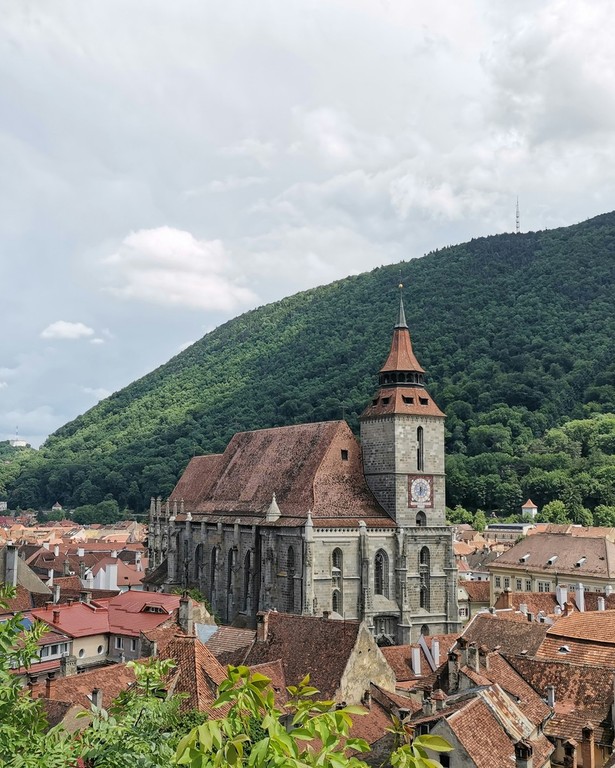
Brașov is one of the Romanian cities where the medieval past can be discovered not only through its major monuments, but also through the details hidden among the streets of the historic center. For first-time visitors, Council Square, the Black Church and Republicii Street are among the best-known landmarks. Yet just a few minutes away on foot, the city reveals another side of its history: that of the old fortress, the guilds and the defensive system that protected the Brașov community for centuries.
A walk through medieval Brașov can begin in Council Square, the historic commercial and administrative center of the city. The square is documented as a marketplace as early as 1520 and remained for centuries one of the main commercial spaces within the fortress. Merchants and craftsmen from the three Romanian principalities, as well as from Western and Eastern Europe, met here. At the center of the square stands the Council House, a building closely connected to the city's administration and today home to the Brașov County Museum of History.
From here, the route can continue towards the Black Church, the monument that dominates the historic center. Few visitors, however, consider the fact that the church's current name is connected to one of the most dramatic events in the city's history. In April 1689, a major fire devastated a large part of Brașov and severely damaged the church. Its roof burned and collapsed, while the interior was covered with debris and ash. According to tradition, the smoke and flames blackened the walls, contributing to the name "Black Church." The reconstruction process lasted for almost a century.
It is then worth leaving the busiest part of the historic center and following the remains of the city's old fortifications. Medieval Brașov was protected by a complex system of walls, towers and bastions, many of which were built or expanded between the 14th and 17th centuries. Today, the city's urban planning documents preserve information about the route of the former defensive walls and the surviving sections of the fortifications.
One of the most interesting points along this route is the Weavers' Bastion. Located at the foot of Mount Tâmpa, it formed part of the defensive system on the southwestern side of the fortress and was defended and maintained by the linen weavers' guild. The construction was carried out in two stages, between 1421 and 1436 and later between 1570 and 1573. With its distinctive shape and massive walls, the bastion offers an insight into the important role played by guilds in the direct defense of the city.
Today, the Weavers' Bastion is part of the Brașov County Museum of History and houses an exhibition dedicated to the fortress and the fortifications of the Țara Bârsei region. The collection includes weapons and other elements associated with the medieval defense system, as well as a model of the old Brașov fortress made in 1896.
Another place worth examining closely is Catherine's Gate. Today it appears as an isolated monument, but in the past it formed part of a much larger defensive complex. The present structure dates from 1559 and is the only surviving element of the former gate complex leading towards Șchei. The four small turrets at the top are not merely decorative: they symbolically represented the authority of the city's magistrate. The façade still bears the coat of arms of Brașov, the name of judge Johannes Benkner and the year of construction.
The gate once provided the connection between the fortress and the Șchei district, and its location reflects the social and urban organization of medieval Brașov. Passing through this area helps visitors understand that the fortified city was not only a commercial center, but also a space where access, movement and relations between different communities were carefully regulated.
From Catherine's Gate, the walk can continue towards Sforii Street, or Rope Street. Today, it is one of the most photographed streets in Brașov, but its origins are more practical than romantic. The narrow passage was originally designed to connect Poarta Street with Cerbului Street and to provide access for firefighters. Its unusual dimensions were therefore linked to the practical needs of the medieval city rather than simply being an architectural curiosity.
To discover even more of the city's defensive character, the route can continue towards Graft Bastion and the old walls. Built in the middle of the 16th century, the bastion had an important strategic role: it connected the city with the White Tower and contributed to the defense of the northern side of the fortress. Today, one of the branches of the Brașov County Museum of History operates here.
Nearby stands the White Tower, another surviving element of the old fortification system. Together with the Black Tower, it provided observation points over the city and the surrounding areas. These structures are important because they allow visitors to imagine Brașov not simply as a city with medieval architecture, but as a fortified settlement organized around defense and the activities of its guilds. The Brașov County Museum of History has incorporated these monuments into the city's cultural heritage circuit and has also hosted exhibitions dedicated to guilds and fortifications.
For a different perspective on the city, the area known as "După Ziduri" ("Behind the Walls") is also worth exploring. Here, the relationship between the old defensive walls and Brașov's natural landscape becomes more apparent. The fortifications were not built at random: the city's geography, the proximity of Mount Tâmpa and the surrounding hills influenced the way the fortress was defended and expanded over the centuries. Official municipal documents include the Brașov fortification complex among the city's historic monuments, with surviving elements dating from the 14th to the 17th centuries.
What makes medieval Brașov particularly fascinating is precisely this layering of history. During the same walk, visitors can move from the square where international markets once took place to a church affected by the great fire of 1689, then to bastions maintained by guilds and gates that once controlled access to the fortress.
The city should not be viewed only through its major monuments. A coat of arms carved into stone, a surviving section of wall, the shape of a street or the structure of a bastion can reveal just as much about Brașov's past as a museum exhibition.
For travelers who want to discover a less obvious side of Brașov, walking through the old fortress is therefore a journey through the city's history. Beyond the familiar photographs of Council Square lies a city shaped by merchants, craftsmen and communities whose lives were organized around trade, guilds and defense.
And it is precisely these details, sometimes overlooked, that can transform a simple visit to Brașov into a genuine discovery of medieval Transylvania.




 International editions: