


Romania’s castles are often associated with architecture, political history, aristocratic families and medieval legends. Yet behind their walls are also stories about people: marriages, families, relationships built over time, separations and lives that unfolded among richly decorated rooms, gardens and vast estates.
Some of these stories are well documented in historical archives and museum collections. Others have been passed down through tradition and have become legends. This combination makes Romania’s castles particularly fascinating for those who want to discover not only the monuments themselves, but also the people who once lived within them.
Peleș: King Carol I and Queen Elisabeth, a royal couple in a residence built for a new dynasty
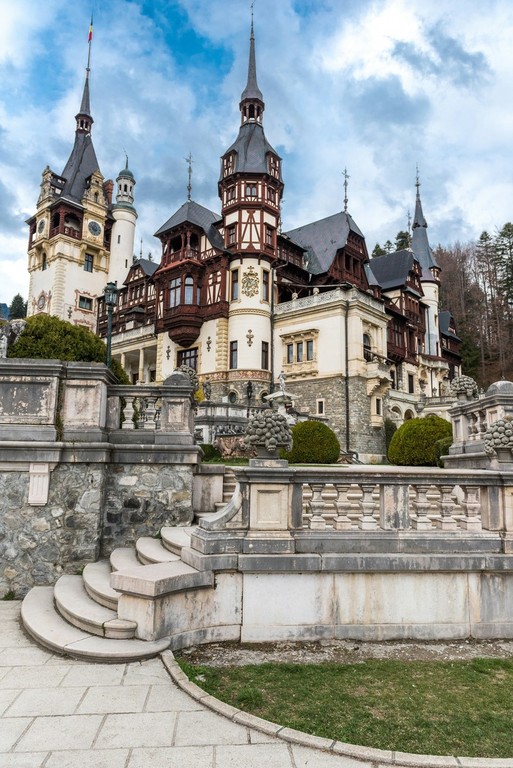
The romantic history of Romania’s castles can begin in Sinaia, at Peleș Castle, one of the country’s best-known royal residences.
Carol I and Elisabeth of Wied married in 1869, and their lives became closely connected with the development of the royal estate in Sinaia. King Carol I began the construction of Peleș Castle in 1875, and the residence was inaugurated in 1883. Documents preserved by the National Peleș Museum show that the inauguration was an important moment for the new dynasty and for the image of modern Romania.
The relationship between the two should not, however, be turned into an idealized love story. Historical sources reveal a complex married life, while Elisabeth, known for her literary and artistic interests, had a personality very different from that of King Carol I.
Peleș nevertheless became one of the principal settings of the royal family's life. Official events, meetings and important family occasions took place here, and the castle remained closely associated with the beginnings of modern Romania's monarchy.
Even the wording of the inaugural document is significant: Carol I signed it together with Elisabeth, referring to the residence as "our house," which became a symbol of the new dynasty.
Pelișor: Ferdinand and Marie and their family home
A short distance from Peleș stands Pelișor, a residence with a much more intimate atmosphere. The castle was built between 1899 and 1902 on the initiative of King Carol I for the Crown Prince Ferdinand and Princess Marie. It was inaugurated on May 24, 1903.
Pelișor is perhaps one of the most appropriate places to explore the family life of a royal couple.
Ferdinand and Marie had six children together, and their residence in Sinaia became an important setting for family life. In the inaugural document of Pelișor, Ferdinand and Marie are presented entering their new home together with their children, in language that explicitly refers to affection and love.
Marie would later recall the family's first homes in Sinaia and the moment when the growing family needed a larger residence. For her, Pelișor was not simply an official residence, but a place associated with everyday family life.
Marie’s personality can also be seen in the design of the castle itself. The queen played an important role in the choice of its style and interior decoration, combining Art Nouveau elements with Byzantine, Celtic and Romanian traditional motifs.
Pelișor therefore tells a story not only about Ferdinand and Marie as a royal couple, but also about the way a family transformed its residence into a personal space.
Bran: Queen Marie and Ferdinand, between royal residence and family life
Bran Castle is now primarily associated with Dracula, but its real history in the 20th century is closely connected with Romania's royal family.
In 1920, the people of Brașov presented the castle to Queen Marie as a gesture of gratitude for her role during the First World War and for her support of Romania's cause. Bran subsequently became one of the queen's favorite residences.
Marie transformed the castle into a more comfortable and personal home. She restored and redecorated its interiors, introduced furniture and works of art, and adapted the medieval structure to the needs of the royal family.
The story of Bran is particularly interesting because it shows how a medieval castle could eventually become a genuine family home.
Queen Marie did not regard Bran simply as an official residence. The castle became a place where the family could spend time together and where the queen welcomed members of the royal family, artists and guests.
The National Bran Museum still preserves objects from the royal collections of King Ferdinand and Queen Marie, confirming the direct connection between the castle and the royal family.
There is, however, an important distinction to make: Bran's connection with the Dracula legend is much more recent and does not represent Queen Marie's actual history. The castle itself notes that Marie had no documented connection with the Dracula legend.
Miclăușeni: George and Maria Sturdza and the castle they built together
In Moldavia, Sturdza Castle in Miclăușeni offers one of the most interesting stories of an aristocratic couple whose lives were closely connected with the residence they created.
The present castle was built between 1880 and 1904 by George A. Sturdza and his wife, Maria, née Ghica, on the site of an older manor house. The couple transformed the estate into a spectacular Neo-Gothic residence featuring numerous decorative elements inspired by the family's heraldic tradition.
George and Maria married in 1869 and settled on the Miclăușeni estate, where they lived as members of the Moldavian aristocracy. The present palace was built during their lifetime and was given a romantic architectural appearance characteristic of the period.
Maria Sturdza played an important role in the cultural and artistic life of the estate, while the castle itself was conceived not only as a residence but also as an expression of the family's identity.
Here, the love story is not found in a spectacular legend, but rather in the fact that two members of an aristocratic family created together the environment in which they lived their lives.
Corvin Castle: Elisabeth Szilágyi and the memory of John Hunyadi
At Corvin Castle, the story is much older and lies at the boundary between history and legend.
John Hunyadi and Elisabeth Szilágyi were one of the important families of 15th-century Transylvania. Following John Hunyadi's death in 1456, the castle came into the possession of Elisabeth Szilágyi and their two sons, Ladislaus and Matthias. In the period that followed, Elisabeth played an important role in the development of the estate and castle.
Corvin Castle preserves legends involving Elisabeth to this day. The best known is the story of the well.
According to the tradition presented by Corvin Castle itself, three Ottoman prisoners were forced to dig a well into the rock after John Hunyadi promised them their freedom if they found water. After Hunyadi's death, the legend says that Elisabeth Szilágyi refused to honor the promise.
Here, the distinction between legend and history is essential. The official Corvin Castle website presents this story as a legend, while the Arabic inscription on the well has a different historical interpretation from the popular version of the tale.
The story can therefore be included in an article about love, family and castles, but it should clearly be presented as a tradition rather than as a proven historical fact.
More significant from a historical perspective is the continuing connection between the Hunyadi family and the castle. After John's death, Elisabeth remained closely connected to the estate and contributed to the development of the residence. The castle thus became a place where the family's memory was preserved and transformed into architecture.
Love, family and memory inside Romania's castles
The stories of these castles show that their romantic character does not always lie in a dramatic love legend.
At Peleș, it is the story of the beginnings of a dynasty and the life of a royal couple who created a residence that became a symbol of modern Romania.
At Pelișor, the story becomes more intimate: Ferdinand and Marie raised their children in a residence that became one of the most personal homes of the royal family.
At Bran, Queen Marie transformed an old fortress into a royal home and a place where the family could live away from the formality of major ceremonies.
At Miclăușeni, George and Maria Sturdza created their own aristocratic world together, leaving behind a castle that still bears the mark of their tastes and ambitions.
And at Corvin Castle, the history of the Hunyadi family is intertwined with legends that have survived for centuries and continue to fascinate visitors.
Perhaps this is the true love story of Romania's castles: not only the stories of two people, but also the connection between people and the places they built, transformed and left behind.
Behind the stone walls are families, children, marriages, ambitions and destinies. And when viewed through these stories, Romania's castles cease to be merely historic monuments and become places where the past seems, for a few moments, remarkably close.




 International editions: