


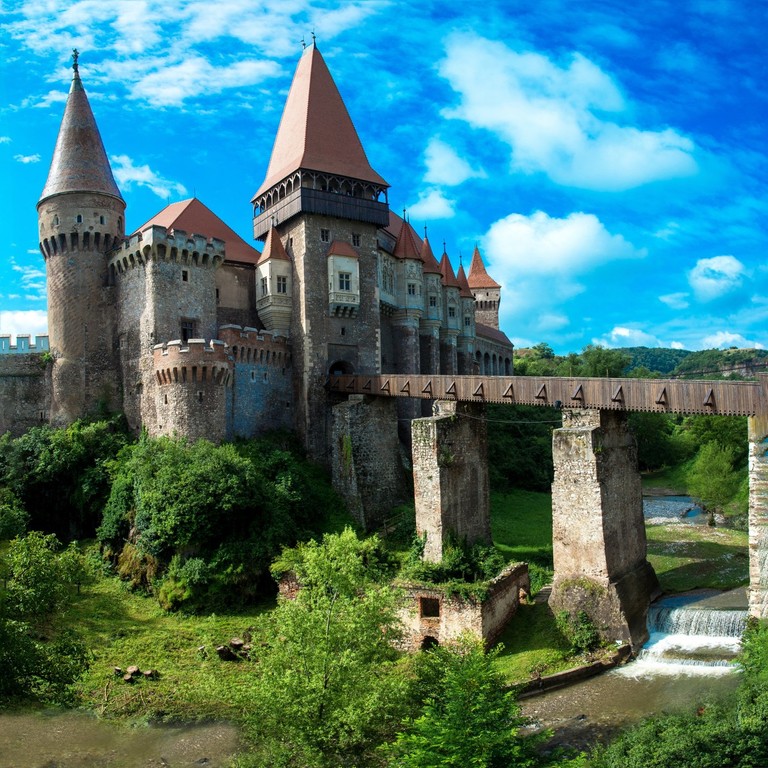
Corvin Castle, also known as Hunyadi Castle, remains one of Romania's most remarkable medieval landmarks. Located in Hunedoara, Transylvania, the impressive fortress attracts visitors interested in history, medieval architecture and the legends that have surrounded its walls for centuries.
With its imposing towers, spectacular entrance bridge, Gothic halls and mysterious passageways, the castle offers an unforgettable journey into Romania's medieval past. Its reputation is further enhanced by stories of prisoners, hidden secrets and supernatural phenomena, including the famous legend of Vlad the Impaler.
Dracula Festival: Where medieval history meets legend
In previous years, Corvin Castle hosted "Dracula Festival", an event dedicated to the historical figure of Vlad the Impaler and the legends surrounding Count Dracula.
The festival sought to bring together historical reality and popular mythology, offering visitors an opportunity to discover the life of the Wallachian ruler behind one of the world's most famous fictional characters.
Its programme included medieval performances, historical documentaries, traditional dances, fire shows, combat demonstrations and interactive activities inspired by medieval life.
Visitors could experience the atmosphere of the Middle Ages through archery demonstrations, sword-fighting lessons, replicas of historical weapons and displays of medieval armour.
The event was associated with Romanian Treasures, an initiative dedicated to promoting Romania's history, traditions and cultural heritage.
However, as of November 2026, no officially confirmed edition of Dracula Festival at Corvin Castle has been identified for the current year.
Vlad the Impaler: The historical figure behind the Dracula legend
One of the most fascinating stories associated with Corvin Castle concerns Vlad III, better known as Vlad the Impaler, the 15th-century ruler of Wallachia.
According to a popular legend, Vlad was imprisoned for seven years in the castle's underground chambers, where his alleged cruelty terrified his guards.
Although this story has contributed to the fortress's mysterious reputation, historians have found no documentary evidence confirming that Vlad the Impaler was imprisoned at Corvin Castle.
Historical accounts establish that Vlad was detained following his arrest in 1462, during the reign of Matthias Corvinus, King of Hungary. His captivity is associated primarily with locations in Hungary, rather than the fortress in Hunedoara.
Nevertheless, the relationship between Vlad the Impaler and the Hunyadi family forms part of the broader political history of medieval Eastern Europe.
The legend continues to fascinate visitors, illustrating how historical events can become intertwined with folklore and popular imagination.
The mysterious legends of Corvin Castle
The story of Vlad the Impaler is not the only legend associated with the medieval fortress.
Another famous tale concerns the castle's well, traditionally believed to have been dug by three Turkish prisoners who were promised their freedom if they succeeded in reaching water.
According to the legend, the prisoners worked for years but were ultimately denied their freedom. The story has become one of the best-known elements of the castle's folklore.
Other tales involve mysterious figures, dark chambers and unexplained occurrences within the fortress.
Although these stories are part of local tradition rather than established historical fact, they contribute to the distinctive atmosphere that makes Corvin Castle such a popular destination for visitors fascinated by medieval mysteries.
A medieval landmark with international recognition
The history of Corvin Castle extends far beyond the Dracula legend.
The fortress underwent major development during the 15th century under John Hunyadi, one of the most influential military and political figures of his time.
Over the centuries, the castle was expanded and transformed, incorporating architectural elements from different historical periods.
Today, visitors can admire its imposing towers, courtyards, ceremonial halls, chapel and other architectural features that reflect its complex history.
The castle has also attracted international film productions, benefiting from its dramatic appearance and authentic medieval atmosphere.
Its connection with cinema, folklore and historical tourism has helped introduce Hunedoara to audiences around the world.
Visiting Corvin Castle in 2026
Corvin Castle remains open to visitors throughout the year, with seasonal opening hours.
According to the official visitor information published for the period from 1 October 2026 to 31 March 2027, the castle operates according to the following schedule:
Monday: 12:00–17:00
Tuesday to Sunday: 09:00–17:00
The standard adult admission fee for 2026 is 55 RON, while students and school pupils benefit from reduced tickets priced at 15 RON. Pensioners pay 30 RON.
Admission includes access to Corvin Castle Museum, the Guilds' House and the Archaeology Exhibition.
Visitors are advised to consult the official website before travelling, as opening hours, admission conditions and special events may change.
Official website: https://www.castelulcorvinilor.ro/.
A place where history and legend come together
Whether attracted by the story of Vlad the Impaler, the mysterious legends of the castle or its exceptional medieval architecture, visitors to Hunedoara can discover one of Romania's most fascinating historical landmarks.
Corvin Castle remains a place where documented history and centuries-old folklore coexist, inviting travellers to explore the past while discovering the stories that have captured the imagination of generations.





 International editions: