


Present on festive tables during Christmas, New Year’s Eve, Easter, and special occasions, this salad has become a true symbol of Romanian cuisine. However, its origins are not Romanian, and its story begins in 19th-century Russia, where one of the world’s most famous salads was created.
The Origin of Salata de Boeuf
Salata de Boeuf traces its roots to the famous “Olivier Salad,” created around 1860 by French chef Lucien Olivier, owner and head chef of the Hermitage Restaurant in Moscow. At the time, the dish was considered a delicacy reserved for the aristocracy and wealthy social classes.
The name “boeuf” comes from French and means “beef,” yet the original recipe was far more sophisticated than the version we know today. Olivier used exclusive ingredients such as game meat, veal tongue, crayfish tails, and caviar, all brought together with a secret sauce inspired by mayonnaise, the exact formula of which was never revealed.
After Lucien Olivier’s death, the recipe was simplified and adapted throughout Eastern Europe, becoming more accessible and better suited to local ingredients.
How It Reached Romania
In Romania, the dish was adopted and reinterpreted during the first half of the 20th century. The luxurious ingredients were replaced with root vegetables, boiled beef, pickled cucumbers, and mayonnaise. Over time, variations made with chicken or turkey also appeared, yet the name “Salata de Boeuf” remained unchanged.
Today, Salata de Boeuf is considered one of Romania’s most iconic festive dishes, even though its origins are international.
Lucien Olivier’s Original Recipe
Although the exact recipe has been lost over time, historical documents and contemporary accounts mention the following ingredients:
Grouse or partridge meat;
Veal tongue;
Crayfish tails;
Caviar;
Pickled cucumbers;
Capers;
Eggs;
Lettuce;
A special mayonnaise-based sauce with secret seasonings.
The dish was served elegantly and was one of Moscow’s gastronomic attractions during that era.
The Classic Romanian Recipe
Ingredients
500 g boiled beef;
4–5 potatoes;
3 carrots;
1 celery root;
2 parsley roots;
4–5 pickled cucumbers;
200 g peas;
400–500 g mayonnaise;
Salt and pepper.
Preparation
The vegetables and meat are boiled separately, then cut into very small, uniform cubes. They are mixed together with the pickled cucumbers and peas, after which the mayonnaise is incorporated. The salad is arranged on a serving platter, covered with a thin layer of mayonnaise, and decorated as desired.
The Modern Reinterpretation – A Return to Its Roots
In recent years, contemporary cuisine has revived the original spirit of Olivier Salad. Many chefs have chosen to reinterpret the dish using premium ingredients that recall the aristocratic recipe of the 19th century.
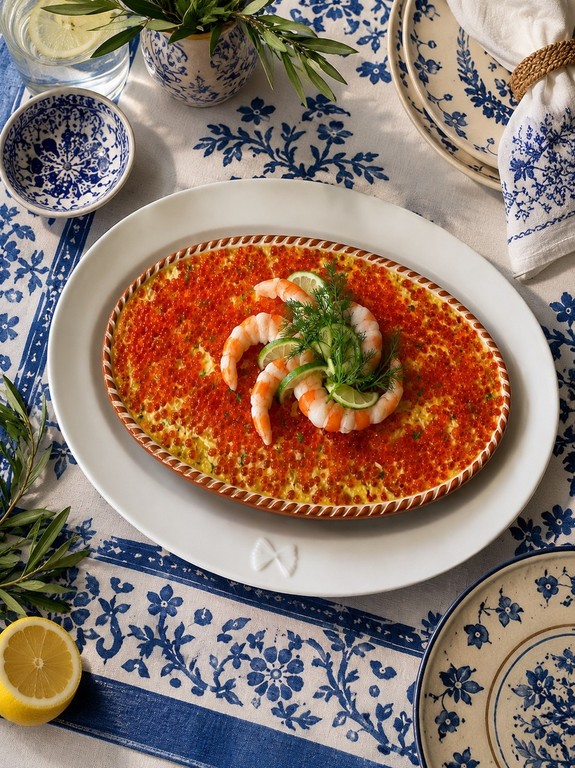
One such reinterpretation is Salata de Boeuf generously decorated with red caviar and shrimp, an elegant presentation that brings the dish closer to the luxury of the original recipe. The caviar provides delicate briny notes and a refined texture, while the shrimp add elegance and visual appeal. Garnishes of fresh dill and lime slices complete the dish with freshness and aromatic balance.
This modern approach does not alter the essence of Salata de Boeuf; rather, it elevates it, demonstrating that a traditional dish can evolve and adapt to contemporary tastes without losing its identity.
Interesting Facts About Salata de Boeuf
In Russia and many Eastern European countries, the dish is known as “Olivier Salad.”
The original recipe contained ingredients considered luxurious even for its time.
The word “boeuf” means “beef,” although many modern versions use chicken or turkey.
The secret to a successful salad lies in the balanced proportion of ingredients and their uniform cutting.
Modern culinary reinterpretations reintroduce ingredients such as caviar, seafood, and aromatic herbs, bringing the dish closer to the version created by Lucien Olivier.
Salata de Boeuf is much more than a festive appetizer. Its story begins in the elegant salons of Imperial Moscow and continues today on Romanian tables. From Lucien Olivier’s sophisticated recipe featuring caviar and crayfish to the traditional version made with vegetables and beef, the dish has crossed generations and cultures. Modern reinterpretations with caviar and shrimp demonstrate that Salata de Boeuf can remain relevant and spectacular while preserving its connection to its aristocratic origins.
Modern Shrimp, Caviar, and Fresh Vegetable Salad
Inspired by the elegance of the famous Olivier Salad, this contemporary reinterpretation replaces beef with the delicate flavors of shrimp and caviar. The result is a refined, fresh, and visually stunning dish, perfect for festive occasions.
Ingredients
500 g cooked shrimp, finely chopped;
2 fresh cucumbers;
200 g sweet corn;
4 hard-boiled eggs;
150 g frozen green peas, blanched for 2–3 minutes and quickly cooled;
300–350 g mayonnaise;
Salt to taste;
Freshly ground black pepper;
200–300 g red caviar for decoration.
Preparation
Cut the cooked shrimp into small pieces.
Dice the fresh cucumbers finely and drain them if they release too much water.
Finely chop the hard-boiled eggs.
Blanch the frozen peas for a few minutes in boiling water, then immediately transfer them to cold water to preserve their vibrant color.
In a large bowl, combine the shrimp, cucumbers, sweet corn, eggs, and peas.
Add the mayonnaise and season with salt and pepper to taste.
Transfer the mixture to a serving platter and smooth the surface evenly.
Generously cover the top with red caviar.
Decorate with whole shrimp, lime slices, and fresh dill for an elegant presentation.
Serving
Refrigerate the salad for at least two hours before serving to allow the flavors to blend harmoniously. The sweetness of the corn, the freshness of the cucumbers, the delicate texture of the shrimp, and the refined notes of the caviar transform this dish into a modern and sophisticated reinterpretation of the famous concept created by Lucien Olivier in the 19th century.
Tip: Using freshly blanched peas instead of canned peas adds extra freshness, color, and texture, enhancing the elegant appearance of the dish.





 International editions: