


Every year on June 24, Romanians across the country and around the world celebrate the Universal Day of the Ia, a holiday dedicated to one of the most valuable creations of Romanian cultural heritage. Chosen to coincide with the traditional celebration of Sânziene, this date highlights the profound connection between the Romanian ia, folk traditions, and national identity.
Today, the ia is regarded as one of the most treasured symbols of Romania’s cultural heritage. Far more than a simple traditional blouse, it represents a form of artistic expression, a cultural identity marker of rural communities, and a living testament to the creativity and sensitivity of the women who embroidered it throughout generations.
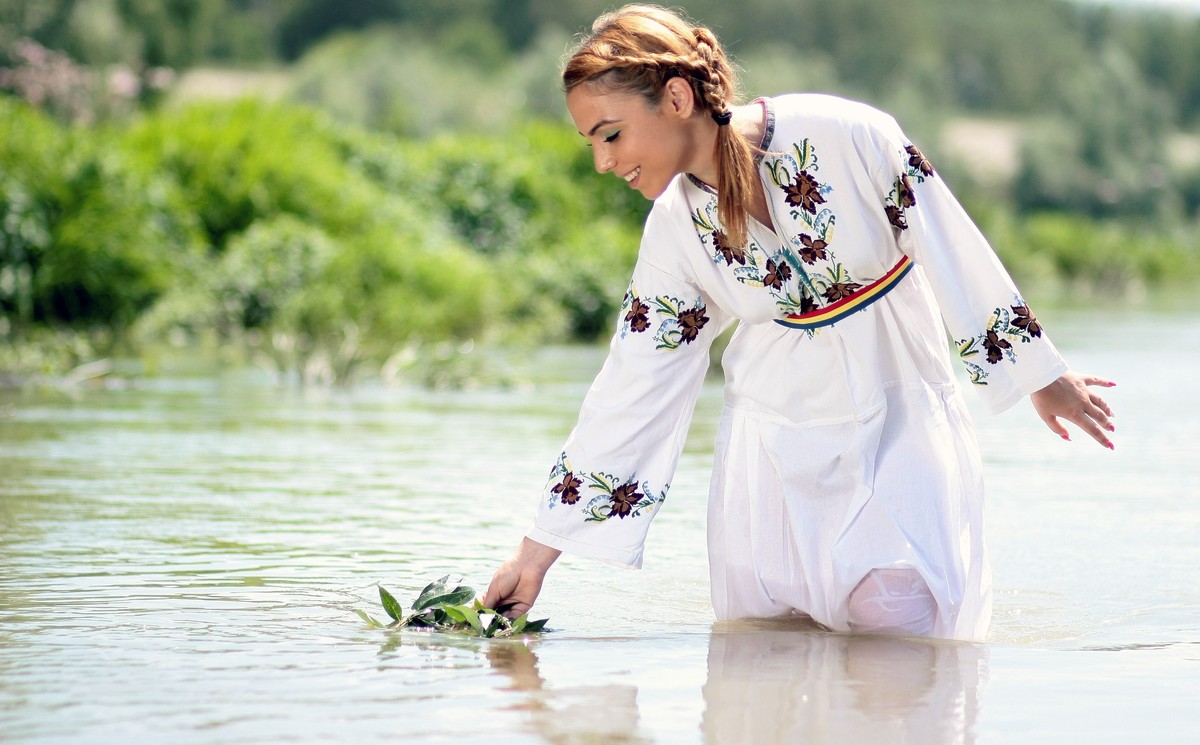
The origins of the ia are lost in the depths of history. Researchers believe that this garment traces its roots to the attire of the ancient Geto-Dacian populations and is the result of centuries of evolution. Although its shape and ornamentation have changed over time under the influence of different historical periods and cultural interactions, the basic structure of the traditional Romanian blouse has remained remarkably consistent. Archaeological discoveries, depictions on ancient monuments, and historical documents reveal the existence of white garments decorated with geometric and floral motifs dating back to pre-Christian times.
In traditional Romanian village life, the ia held a central place in a woman’s existence. Every girl began learning the art of embroidery from an early age, and creating an ia was considered proof of her diligence, talent, and patience. A significant part of a young woman’s dowry consisted of hand-embroidered blouses prepared for life’s most important occasions, including religious celebrations, weddings, baptisms, and other community events.
The process of creating an authentic ia was labor-intensive and often required months of work. The materials used came from the household and were obtained through traditional methods. Flax and hemp were cultivated, harvested, and processed by hand, while the threads were woven on traditional looms. Later, cotton and silk became highly valued for their delicacy and elegance. Once the fabric was completed, the most intricate stage began: embroidery.
Every stitch had a specific purpose. Decorative motifs were never chosen randomly; they conveyed messages and beliefs passed down from generation to generation. The sun symbolized life and energy, the ear of wheat represented prosperity and fertility, while the Tree of Life embodied family continuity and the connection between generations. Diamonds, spirals, stars, and other geometric figures often served protective functions and were believed to shield the wearer from evil and negative influences.
One of the most fascinating aspects of the Romanian ia is its regional diversity. Although it follows the same general structure, each ethnographic region developed its own distinctive patterns, techniques, and color combinations. In Maramureș, rich embroidery and vibrant colors predominate, while in Moldavia delicate and elegant motifs are crafted with exceptional precision. In Oltenia and Muntenia, elaborate geometric patterns are common, whereas the Muscel area is renowned for the refinement and balance of its decorative compositions.
The defining feature of the ia is the altiță, the richly ornamented shoulder panel considered by specialists to be one of the most valuable achievements of Romanian textile art. Together with the încreț and the vertical embroidered bands known as râuri, it forms a complex decorative composition that gives each blouse its harmony and uniqueness. It is precisely this distinctive structure that has earned the Romanian ia international recognition and appreciation.
Over time, the beauty of the ia has transcended Romania’s borders and captured the attention of artists and creators around the world. Painters, photographers, and fashion designers have drawn inspiration from the elegance and symbolism of this traditional garment. During the twentieth century, the ia became a symbol of authenticity and Eastern European refinement, influencing numerous fashion collections and works of art.
Today, the Romanian ia is experiencing a remarkable revival. After decades in which traditional costume was viewed primarily as a folkloric element, interest in traditional craftsmanship has grown considerably. Increasing numbers of artisans and specialized workshops are striving to preserve authentic embroidery techniques and pass their knowledge on to younger generations. At the same time, many contemporary designers incorporate elements inspired by the traditional ia into modern creations, demonstrating that tradition and innovation can coexist harmoniously.
The cultural value of the Romanian ia has also been recognized internationally. The blouse with altiță, a representative element of Romanian and Moldovan traditional costume, has been inscribed on the Representative List of the Intangible Cultural Heritage of Humanity. This recognition is not only a validation of its artistic beauty but also a tribute to the communities that have kept this tradition alive for centuries.
Today, the ia is worn at both traditional celebrations and modern events. It can be seen on cultural stages, in museums, at festivals, in fashion photography, and even as part of contemporary urban outfits. Regardless of the setting, the ia continues to convey the same message: respect for one’s roots, appreciation for the beauty of handmade craftsmanship, and the profound connection between individuals and their communities.
More than a piece of clothing, the Romanian ia is an expression of collective memory. Every embroidered pattern, every thread, and every symbol bears the imprint of the generations that created and preserved this invaluable heritage. Woven into its stitches are stories of family, faith, nature, love, and hope. For this reason, the ia remains one of the most powerful symbols of Romanian identity—a bridge between past and future, between tradition and modernity.




 International editions: