


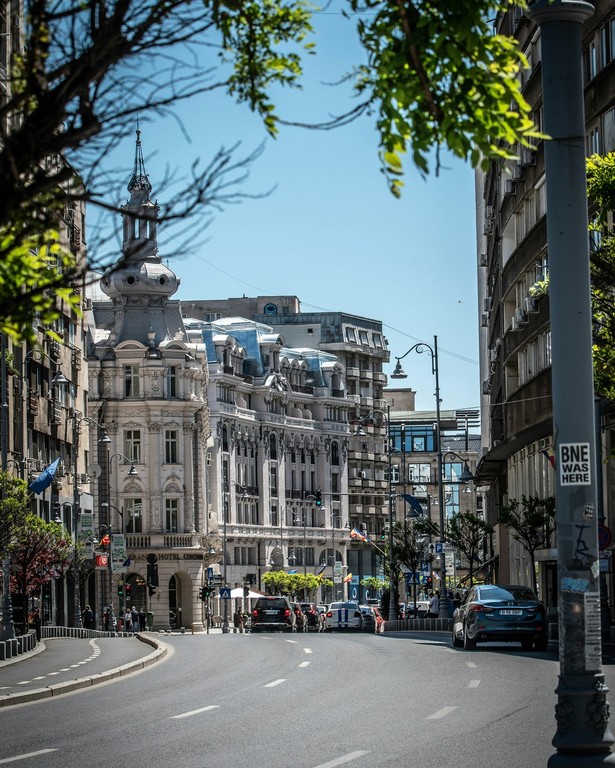
Neighborhoods such as Cotroceni, the Kiseleff area and the Armenian Quarter preserve historic buildings, villas, gardens and monuments that reflect different periods in the city's history.
A route of this kind can begin in Cotroceni, continue towards the Kiseleff and Dorobanți areas, and end in the Armenian Quarter, offering an insight into Bucharest's architectural and cultural heritage.
Cotroceni
Cotroceni Palace and its grounds
Cotroceni Palace is one of Bucharest's important heritage buildings. The estate was associated with Romania's royal family, and today Cotroceni Palace houses the National Cotroceni Museum.
The complex preserves representative spaces from the former royal residence, as well as elements reflecting the architectural evolution of the site. The museum can be visited according to the programs and guided tours established by the institution.
The Gheorghe Tattarescu House
Located on Domnița Anastasia Street, the Gheorghe Tattarescu House is a historic monument associated with the Romanian painter Gheorghe Tattarescu.
The house was purchased by the artist in 1855 and served both as a residence and a studio. Tattarescu was one of the important figures of 19th-century Romanian painting, and the house remains closely connected to his life and artistic activity.
The building is currently undergoing consolidation and renovation, so public access should be checked before visiting.
The National Museum of Maps and Old Books
Another possible stop is the National Museum of Maps and Old Books, housed in a villa at 39 Londra Street.
The museum holds an important collection of maps and other cartographic documents, and the institution also has a community garden. The outdoor space is used for activities and programs organized by the museum.
Kiseleff and Dorobanți
The route can continue towards the Kiseleff area, one of the parts of Bucharest where parks, historic buildings and residential architecture from different periods can be found side by side.
Minovici Villa
Minovici Villa, now known as the Dr. Nicolae Minovici Museum of Popular Art, is one of Bucharest's representative examples of Neo-Romanian architecture.
The building was designed by architect Cristofi Cerchez and constructed at the beginning of the 20th century for physician and collector Nicolae Minovici. The museum displays Romanian folk art objects from his collection.
The villa and its surrounding area are an important destination for those interested in Bucharest's architecture and cultural heritage.
Kiseleff Park
Kiseleff Park is one of the capital's historic green spaces. Its development is connected to the modernization of Bucharest during the 19th century, and it was named after Russian general Pavel Kiseleff.
A walk through the park can be combined with an exploration of the surrounding streets, where visitors can find numerous historic buildings and examples of residential architecture.
The Armenian Quarter
Another stop on the route is the Armenian Quarter, a historic area associated with Bucharest's Armenian community. The streets in this part of the city preserve numerous buildings and architectural details that reflect the development of the community and the urban evolution of Bucharest.
The Armenian Church
The Armenian Church of Saints Archangels Michael and Gabriel is one of the area's main landmarks.
The present church was built between 1911 and 1915, following the design of architect Dimitrie Maimarolu. Older Armenian places of worship had previously stood on the same site, reflecting the area's longstanding connection with Bucharest's Armenian community.
The church complex is an important landmark for understanding the history of the Armenian community in the Romanian capital.
Armenească Street and the surrounding streets
A walk along Armenească Street and the neighboring streets offers an opportunity to discover historic houses and architectural details preserved within the neighborhood's urban fabric.
The area can be explored on foot, with the route continuing towards other historic buildings and monuments in central Bucharest.
Speranței Street
Speranței Street forms part of the historic urban fabric of central Bucharest. Along the street, visitors can see buildings from different periods and architectural styles, contributing to the character of the capital's older neighborhoods.
Historic Houses and Cultural Figures
Bucharest is closely connected with numerous figures from Romanian culture, and some of the buildings associated with them have been transformed into museums or memorial spaces.
George Enescu
One of the most important such places is Cantacuzino Palace at 141 Calea Victoriei, which houses the George Enescu National Museum.
The complex also includes the memorial house behind the palace, associated with the life of composer George Enescu and his wife, Maria Cantacuzino.
Bucharest and Gheorghe Tattarescu
The Gheorghe Tattarescu House is another important place for discovering Bucharest's cultural heritage. The direct connection between the building, the artist's residence and his studio provides an insight into artistic life in Bucharest during the 19th century.
How to Explore the Route
The best way to discover these areas is on foot, with stops at the sites that are open to visitors.
It is advisable to check museum opening hours and access conditions in advance, as some historic buildings are not permanently open to the public.
When visiting areas with private properties, visitors should respect residential spaces and should not enter courtyards or private properties without permission.
A camera can be useful for capturing architectural details such as façades, windows, ornaments, gates and decorative elements that give character to Bucharest's historic streets.
Bohemian Bucharest is not confined to a single place. It can be discovered gradually, among historic buildings, museums, parks and streets that have preserved fragments of the city's past. From Cotroceni and Kiseleff to the Armenian Quarter, a careful walk reveals a Bucharest shaped by different eras, architectural styles and stories.




 International editions: