


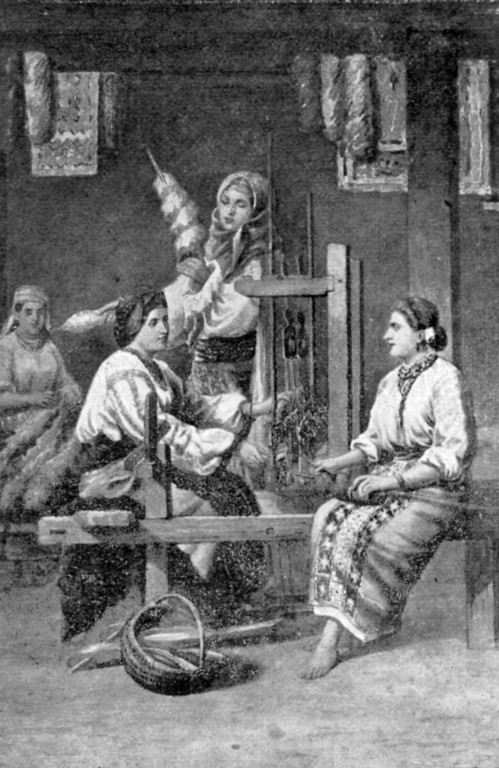
After the agricultural work and household chores were finished, people gathered around their traditional handicrafts. This was the setting in which the șezătoare developed, one of the traditional forms of social gathering in rural Romanian life.
The șezătoare was not simply an occasion for sewing, spinning, weaving or knitting. It was also a place where members of the community met, talked, laughed and passed customs and knowledge from one generation to the next. Women and girls would usually gather in one of the village homes, bringing with them the work they needed to complete.
Wool was spun, threads were prepared for weaving and fabric was embroidered with patterns characteristic of the local area. Around these apparently simple activities, a lively social world unfolded. News was exchanged, stories were told, events in the village were discussed, and jokes, riddles and traditional tales were shared.
For young women, the șezătoare also played an important educational role. Girls learned sewing, spinning and weaving techniques from older women, as well as traditional motifs that could vary considerably from one region to another. In this way, handicrafts were passed directly from one generation to the next through observation and practice.
The șezătoare was also a place for storytelling. Before radio, television and the internet became part of everyday life, gatherings of this kind were among the ways information circulated within rural communities. A story told by an older woman could become part of the collective memory of the village, while a song, proverb or saying could be learned and passed on to others.
In some communities, these gatherings also played a role in social relationships among young people. The șezătoare provided a setting in which young women and men could meet within a framework accepted by the community. Games, songs and good-natured teasing complemented the evenings, when handwork alternated with moments of entertainment.
From one region to another, șezători could take different forms. In Transylvania, Bucovina, Maramureș, Moldavia and the Subcarpathian regions, the activities carried out during these gatherings were closely connected to local crafts and traditional dress. Embroidery motifs, working techniques and handmade objects reflected the identity of each community.
The importance of the șezătoare, however, went beyond the objects that were produced. A traditional blouse, shirt, tablecloth or woven textile was the result of patience and skill, but also of a collective learning process. While working, techniques were demonstrated and practiced, turning tradition into something experienced together rather than simply inherited.
As rural life changed, the traditional șezătoare gradually disappeared from everyday life. Industrialisation, migration from villages to towns and cities, and the emergence of new forms of entertainment and communication reduced the need for gatherings of this kind.
Yet the tradition has not disappeared entirely. In many Romanian communities, folk artisans, cultural centres and local groups are working to bring the șezătoare back into public attention. Today, organised gatherings can offer younger generations the opportunity to discover traditional techniques such as embroidery, weaving, spinning and knitting, while also learning about the stories and customs associated with them.
Seen from the perspective of the present, the șezătoare tells the story of a society in which work and social life were not separate activities. A handmade object could be started during one evening and continued at subsequent gatherings, while stories, songs and knowledge passed naturally between generations.
Beyond the beauty of the objects created, the true value of the șezătoare perhaps lay in its community spirit. It was a place where people worked together, learned from one another and kept the memory of the village alive. For the rural communities of the past, an evening spent at a șezătoare meant not only work, but also the simple and meaningful experience of being together.





 International editions: