


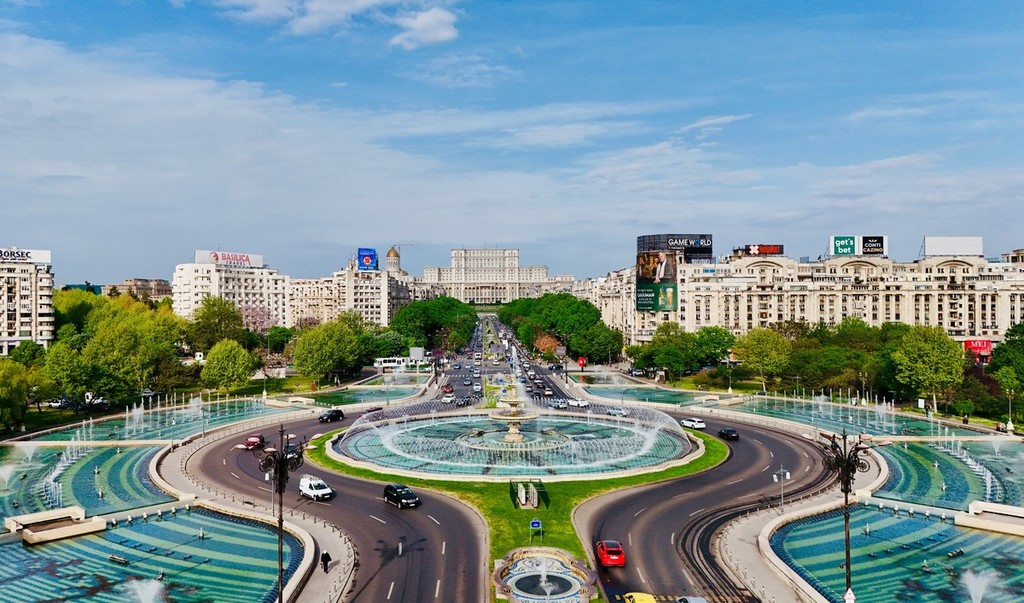
Located in the southeastern part of the country, on the banks of the Dâmbovița River, the city is known for its rich history, impressive architectural heritage, and the essential role it has played in the development of modern Romania. Over time, Bucharest has been nicknamed “Little Paris” due to the elegance of its buildings, its wide boulevards, and the influence of French culture on urban life during the nineteenth and twentieth centuries.
The history of Bucharest began long before its first documented mention. Archaeological discoveries show that the area where the city stands today was inhabited since prehistoric times, with evidence of human settlements dating back to the Stone Age and the Bronze Age. In ancient times, the region was populated by Geto-Dacian tribes, which contributed to the formation of the local culture and civilization. However, the first official mention of Bucharest dates back to September 20, 1459, in a document issued by Vlad the Impaler, ruler of Wallachia. This document confirms the existence of the Bucharest fortress and marks what is now considered the official birth of the city.
Thanks to its strategic location, Bucharest quickly became an important military, commercial, and administrative center. In 1659, the city was established as the permanent capital of Wallachia, replacing the former capital, Târgoviște. Throughout the following centuries, Bucharest experienced continuous growth, although it was affected by numerous fires, epidemics, floods, earthquakes, and armed conflicts. Nevertheless, its inhabitants managed each time to rebuild and modernize the city.
The nineteenth century was one of the most important periods in the history of Bucharest. After the Union of the Romanian Principalities in 1859, the city became the capital of the new Romanian state and entered a broad process of modernization. Impressive public buildings, schools, hospitals, theaters, and cultural institutions were constructed, while urban infrastructure was improved through the introduction of public lighting, water supply systems, and modern transportation. During this period, the city's grand boulevards were laid out and many of the buildings that still define the image of the capital today were erected.
At the end of the nineteenth century and the beginning of the twentieth century, Bucharest experienced a period of economic and cultural prosperity. Architecture inspired by major European capitals, especially Paris, contributed to the emergence of the nickname “Little Paris.” Landmark buildings such as the Romanian Athenaeum, the CEC Palace, the Arch of Triumph, and numerous palaces, villas, and public institutions were built, giving the city an elegant and cosmopolitan appearance. During the same period, Bucharest became an important artistic and intellectual center, attracting writers, artists, scientists, and political figures from across the country.
During the two World Wars, the city went through difficult times. In World War I, it was occupied by the Central Powers, while in World War II it suffered bombings that caused significant material destruction and loss of life. After the war and the establishment of the communist regime, Bucharest entered a new phase of development. Large residential districts, factories, and infrastructure typical of the socialist period were built. A dramatic moment occurred on March 4, 1977, when a major earthquake caused extensive damage and deeply affected the city.
In the 1980s, the communist regime launched a vast urban systematization program. Numerous historic neighborhoods and monuments were demolished to make way for the Civic Center and the Palace of the Parliament, one of the largest administrative buildings in the world. These transformations profoundly changed the appearance of the capital, eliminating an important part of its historical heritage.
An essential moment in Bucharest’s recent history was the Romanian Revolution of December 1989. The capital was the main center of the demonstrations that led to the fall of the communist regime and Romania’s return to democracy. After 1990, the city entered a period of economic and urban transformation, becoming the country’s main financial and business center and one of the most important cities in Southeastern Europe.
Today, Bucharest is a modern city with more than one and a half million inhabitants, combining historic monuments with contemporary buildings and business districts. The city hosts the fundamental institutions of the Romanian state, the country’s most important universities, museums, theaters, and cultural centers. Among its best-known tourist attractions are the Palace of the Parliament, the Romanian Athenaeum, the Arch of Triumph, the Village Museum, Calea Victoriei, the Old Town, and numerous parks that offer residents and visitors spaces for recreation and relaxation.
Bucharest Day is celebrated annually on September 20, commemorating the city’s first documented mention in 1459. On this occasion, concerts, exhibitions, performances, and cultural events are organized to celebrate the history and identity of the capital. This day represents a source of pride for the city’s inhabitants and an opportunity to reflect on its evolution throughout the centuries.
Today, Bucharest is a symbol of Romania’s development and modernization, a city that has overcome numerous historical challenges and has continually reinvented itself. From the fortress mentioned by Vlad the Impaler in the fifteenth century to the contemporary European metropolis, Bucharest remains a place of contrasts, cultural diversity, and a fascinating history that continues to be written by present and future generations.




 International editions: