


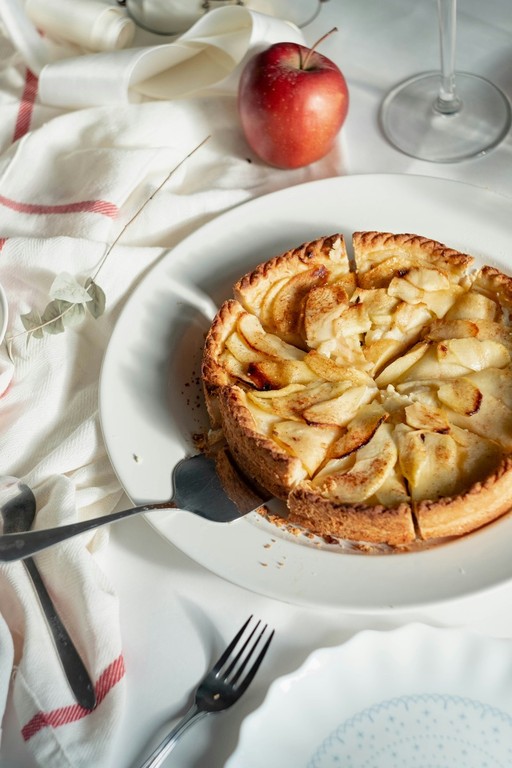
Italian apple tart, known as "crostata di mele", is one of those desserts that immediately brings to mind the comforting aroma of home cooking, family recipes passed down through generations, and the pleasure of simple, homemade treats. A crumbly shortcrust pastry base, fresh apples, a touch of lemon, and, depending on personal preference, a pinch of cinnamon: just a few ingredients come together to create a dessert with a delicate flavor and a delightful texture.
Popular in many regions of Italy, apple tart is appreciated for its versatility. It can be enjoyed for breakfast, served with afternoon tea, or offered as a dessert after a family meal. Although numerous variations exist, the homemade version made with shortcrust pastry and apples remains one of the best known.
The origins of apple tart cannot be traced with certainty to a single place or a specific date. Its history belongs to the long European tradition of preparing pastries with fruit, a culinary practice that developed over many centuries.
Even in ancient times, apples were used in various food preparations. The Romans ate them fresh, cooked, or preserved, often accompanied by honey, one of the main sweeteners available before sugar became widespread.
During the Middle Ages, various European regions developed dishes in which fruit was enclosed in pastry. However, these preparations differed from modern tarts, both in their ingredients and in the techniques used to make them.
Over the centuries, as sugar, butter, and more refined pastry-making techniques became increasingly common, desserts gradually evolved into forms resembling the cakes and tarts we know today.
In Italy, the crostata became established as a dessert characterized by a shortcrust pastry base, often filled with jam, custard, or fresh fruit. The apple version became one of the many expressions of traditional home baking, thanks to the availability of apples and the simplicity of the ingredients.
Unlike other desserts associated with a standardized recipe or a specific local tradition, there is no single original recipe for Italian apple tart. Each family may have its own version, with differences in the amount of sugar, the thickness of the pastry, the arrangement of the fruit, and the flavorings used.
Apples are among the most widely used fruits in traditional European desserts. In Italy, apple cultivation is particularly important in the northern regions, especially Trentino-Alto Adige and certain mountainous areas, where climatic conditions favor the production of different varieties.
In the kitchen, apples can be used in numerous preparations, from soft apple cakes and strudels to spoon desserts and tarts.
Italian apple tart differs from a classic apple cake because of its shortcrust pastry, which forms a firm, crumbly base topped with fruit.
The recipe can be enriched with pastry cream, apricot jam, almonds, or cinnamon, but the simplest version allows the natural flavor of the apples to shine through.
Traditional Italian Apple Tart Recipe
This recipe is a classic homemade version, prepared with buttery shortcrust pastry and fresh apples, without pastry cream. It is not intended to represent the only original recipe, but rather a preparation that remains faithful to the traditions of Italian home baking.
Preparation time: Approximately 25 minutes
Resting time: 30 minutes
Baking time: 35–45 minutes
Difficulty: Easy
Servings: 8
Tart pan: 24 cm (approximately 9.5 inches) in diameter
Ingredients for the Shortcrust Pastry
300 g all-purpose flour
150 g cold butter
100 g sugar
1 whole egg
1 egg yolk
Grated zest of 1 unwaxed lemon
A pinch of salt
Ingredients for the Apple Filling
3–4 medium apples, approximately 500–600 g after removing the cores and any peel
40 g sugar
2 tablespoons lemon juice
2 tablespoons apricot jam
½ teaspoon ground cinnamon (optional)
10 g butter (optional)
Step-by-Step Preparation
1. Prepare the Shortcrust Pastry
Place the flour in a large mixing bowl and add the cold butter, cut into small cubes. Quickly rub the ingredients together with your fingertips until the mixture resembles coarse breadcrumbs.
Add the sugar, whole egg, egg yolk, grated lemon zest, and a pinch of salt.
Mix briefly until a smooth dough forms, avoiding excessive kneading so that the butter does not become too warm.
Shape the dough into a disc, wrap it in plastic wrap, and refrigerate for at least 30 minutes.
2. Prepare the Apples
Wash the apples, peel them if preferred, and remove the cores.
Cut them into thin, evenly sized slices to ensure uniform baking.
Transfer the slices to a bowl and add the lemon juice, sugar, and cinnamon, if using.
Mix gently to distribute the ingredients without breaking the apple slices.
The lemon juice helps prevent the apples from browning, while the sugar enhances their natural sweetness during baking.
3. Roll Out the Pastry
Preheat a conventional oven to 180°C (350°F).
Grease and flour a tart pan approximately 24 cm (9.5 inches) in diameter, preferably one with a removable base.
Remove the chilled dough from the refrigerator and roll it out on a lightly floured surface until it is approximately 4–5 mm thick.
Carefully transfer the pastry to the tart pan, pressing it gently against the bottom and sides.
Trim away any excess dough and lightly prick the base with a fork.
4. Fill the Tart
Spread a thin layer of apricot jam over the bottom of the pastry.
Arrange the apple slices in concentric circles, overlapping them slightly until the entire surface is covered.
For a more decorative presentation, arrange the slices in a spiral, starting from the outer edge and working toward the center.
If desired, add a few small pieces of butter over the apples.
The apricot jam enhances the flavor and creates a light layer between the fruit and the shortcrust pastry.
5. Bake the Tart
Place the tart in the preheated oven at 180°C (350°F) and bake for approximately 35–45 minutes.
The exact baking time may vary depending on the oven, the thickness of the pastry, and the amount of apples used.
The tart is ready when the pastry edges are golden brown and the apples are tender, with a lightly caramelized surface.
If the top begins to brown too quickly, loosely cover it with aluminum foil during the final minutes of baking.
6. Cool and Serve
Once baked, remove the tart from the oven and allow it to cool in the pan for at least 20–30 minutes.
When it is firm enough, carefully transfer it to a serving plate.
It can be served at room temperature or slightly warm.
For a glossy finish, brush the apples with a tablespoon of gently warmed apricot jam diluted with a very small amount of water.
The choice of apples influences both the flavor and the final texture of the dessert.
Golden Delicious apples are particularly suitable because of their natural sweetness and flesh, which becomes tender during baking.
Renette apples, with their more intense and slightly tart flavor, are often used in traditional baking and provide a pleasant contrast to the sweetness of the shortcrust pastry.
Granny Smith apples, which are firmer and more acidic, are ideal for those who prefer a less sweet tart with apple slices that retain more of their shape.
Fuji and Gala apples can also be used, especially by those who enjoy a naturally sweeter flavor.
A useful tip is to combine two different varieties, one sweeter and one more acidic, to achieve a balanced taste.
The success of a good apple tart depends largely on the preparation of the shortcrust pastry.
The butter should be cold, and the dough should be handled as little as possible. Overworking the dough encourages gluten development, which can make the pastry less tender and crumbly.
Refrigerating the dough is important because it allows the butter to firm up and makes the pastry easier to roll out.
The pastry should also be rolled to an even thickness to prevent some areas from becoming overbaked while others remain undercooked.
Finally, it is advisable to avoid excessively watery apples and not to leave the sliced fruit mixed with sugar for too long, as this can cause it to release too much liquid.
Italian apple tart can be prepared in numerous ways, depending on personal tastes and family traditions.
One of the most popular variations includes a layer of pastry cream beneath the apple slices, making the dessert softer and richer.
Another option is to use a thin layer of apricot or apple jam to add an extra fruity note.
For a more rustic flavor, part of the all-purpose flour can be replaced with whole wheat flour, while adding ground almonds gives the tart a different texture.
Cinnamon is one of the most commonly used spices, but it can be replaced or complemented with vanilla and lemon zest.
There are also versions made with oil-based shortcrust pastry instead of butter, as well as lactose-free variations suitable for different dietary needs.
Apple tart without pastry cream can be stored for approximately two days at room temperature, provided it is kept in a cool, dry place, properly covered, and away from heat sources.
If the room temperature is high, it is preferable to store the tart in the refrigerator in a sealed container.
Before serving, it can be left at room temperature for a few minutes or briefly warmed in the oven to restore some of the pastry's crispness.
Tarts prepared with pastry cream, however, must be refrigerated and consumed within a shorter period.
Italian apple tart is one of the most recognizable examples of traditional Italian home baking, where everyday ingredients are transformed into desserts that accompany both ordinary moments and special occasions.
Despite the evolution of pastry-making and the growing popularity of increasingly elaborate desserts, this classic tart continues to be appreciated for its simplicity, the comforting aroma of baked apples, and the crumbly texture of its shortcrust pastry.
Preparing it at home also means rediscovering the pleasure of traditional recipes, which require no complicated techniques, just quality ingredients, attention to detail, and a little patience.
A slice of Italian apple tart, perhaps accompanied by a cup of tea or coffee, is a simple pleasure that has been enjoyed across generations and continues to hold a special place on Italian tables.




 International editions: