


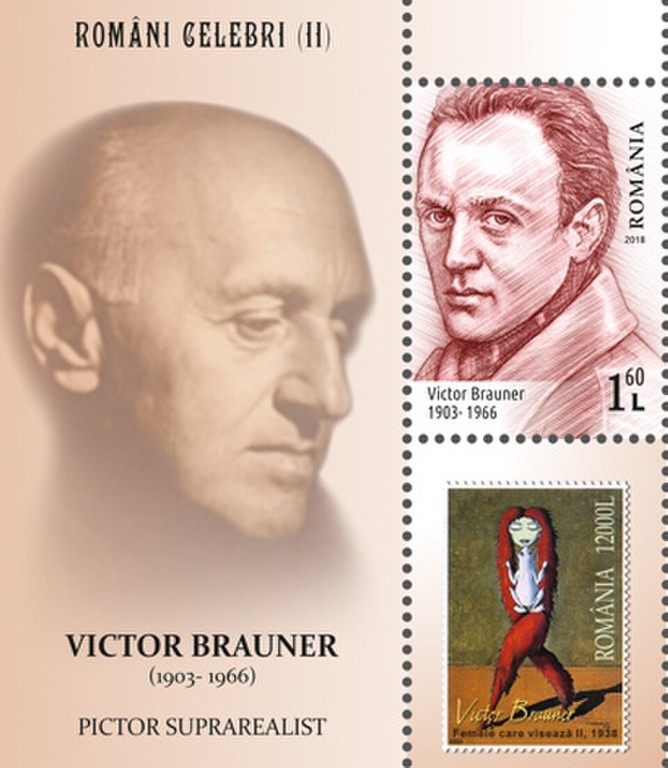
Painter, draughtsman, sculptor and theorist of the imagination, Victor Brauner created a unique artistic universe populated by symbols, hybrid beings, personal myths and visionary images that continue to fascinate audiences and art critics around the world.
Origins and Early Life
Victor Brauner was born on 15 June 1903 in Piatra Neamț, Romania, into a Jewish family. His father was deeply interested in spiritualism and frequently organized séances, experiences that would profoundly influence the artist's imagination and his later fascination with occultism, magic and symbolism.
The family lived for a period in Vienna before returning to Romania. Brauner studied at the National School of Fine Arts in Bucharest, although his rebellious and nonconformist spirit often brought him into conflict with the academic environment.
Artistic Beginnings and the Romanian Avant-Garde
During the 1920s, Brauner emerged as one of the leading figures of the Romanian avant-garde. He collaborated with experimental magazines such as 75 HP and unu, publications that promoted Dadaism, Constructivism and Surrealism. During this period, he explored Expressionism, Cubism, Dadaism and abstraction in succession, constantly searching for new forms of artistic expression.
His first solo exhibition took place in Bucharest in 1924, and in 1925 he travelled to Paris for the first time, a city that would decisively shape his artistic destiny.
Paris and the Discovery of Surrealism
From the 1930s onward, Brauner divided his time between Bucharest and Paris. In the French capital, he came into contact with the Surrealist circle led by André Breton and artists such as Yves Tanguy. In 1933, he officially joined the Surrealist group and was quickly recognized as one of its most original voices.
Unlike many of his contemporaries, Brauner was not solely interested in dreams and the unconscious. He combined esoteric symbolism, alchemy, Kabbalah, mythology and Eastern European folklore to develop a highly personal visual language.
The Famous Story of the Lost Eye
One of the most remarkable episodes of Brauner's life contributed to his almost legendary status within the Surrealist movement.
In 1931, he painted a self-portrait depicting himself with a missing eye. Seven years later, in 1938, during an altercation involving fellow Surrealist artists, he was accidentally struck by a shattered glass and permanently lost his left eye. Many of his contemporaries interpreted this extraordinary coincidence as a form of premonition, reinforcing his reputation as a visionary artist.
The motif of the eye subsequently became one of the recurring symbols throughout his work.
Exile and the Years of the Second World War
The rise of antisemitism and the approach of war led Brauner to leave Romania permanently. He settled in France in 1938, where he would remain for the rest of his life. During the Nazi occupation, he was forced into hiding because of his Jewish origins. This difficult period deepened his interest in magic, esotericism and symbolic imagery.
Throughout the war years, he continued to experiment with new materials and techniques, developing an increasingly complex iconography populated by fantastic creatures, totemic figures and mystical symbols.
Artistic Style
Victor Brauner's work defies easy categorization. Its most distinctive characteristics include:
dream-inspired and subconscious imagery;
human figures transformed into hybrid creatures;
magical and alchemical symbols;
a fascination with occultism and spirituality;
vivid colours and flattened, almost hieratic compositions;
influences drawn from folk art and Eastern European mythology.
His preferred themes included identity, transformation, destiny, eroticism, mystery and humanity's relationship with the universe.
Major Works
Among his most celebrated creations are:
Self-Portrait (1931);
Loup-Table (1939);
Le Surmâle;
Le Prélèvement;
Tableau autobiographique (1948);
Meeting with Myself at the Four Cats of the World, one of his late masterpieces.
Today, many of his works can be found in major museums worldwide, including the collections of the Museum of Modern Art, the Solomon R. Guggenheim Museum, the Centre Pompidou and other leading institutions of modern art.
Brauner and Romania
Although he spent most of his artistic career in France, Victor Brauner remains one of Romania's most significant contributions to modern art. For many years he remained relatively unknown in his homeland, but interest in his work has grown considerably in recent decades. In 2023, the National Museum of Art in Timișoara hosted one of the largest retrospectives dedicated to the artist in Eastern Europe, bringing together more than one hundred works from major European collections.
Legacy
Victor Brauner died in Paris on 12 March 1966 at the age of sixty-two. He became a French citizen in 1963, yet his Romanian origins remained an essential component of his cultural identity.
Today, he is regarded as one of the major figures of international Surrealism, alongside artists such as Salvador Dalí, Max Ernst and René Magritte. The originality of his work lies in its ability to merge the Western avant-garde with mythology, spirituality and the imaginative traditions of Eastern Europe, creating a unique and unmistakable artistic universe.
International interest in Brauner's work remains remarkably strong. A striking example is the major exhibition Victor Brauner: L'Aventure magique, held at Villa Paloma, part of the Nouveau Musée National de Monaco, from 3 July 2026 to 3 January 2027. Curated by Camille Morando, the exhibition brings together more than 160 paintings, drawings and sculptures, primarily drawn from an important private collection. The exhibition traces the full trajectory of Brauner's artistic development, from his Romanian avant-garde years to his final creations, highlighting the symbolic, mythological and visionary dimensions that established him as one of the leading figures of modern European art.
In the history of Romanian art, Victor Brauner is widely recognized as the country's foremost representative of Surrealism and one of the few Romanian artists to have exerted a significant influence on modern art worldwide. His work continues to inspire through the power of imagination, the originality of its visual language and its ability to transform symbols, dreams and myths into a universal form of artistic expression.




 International editions: