


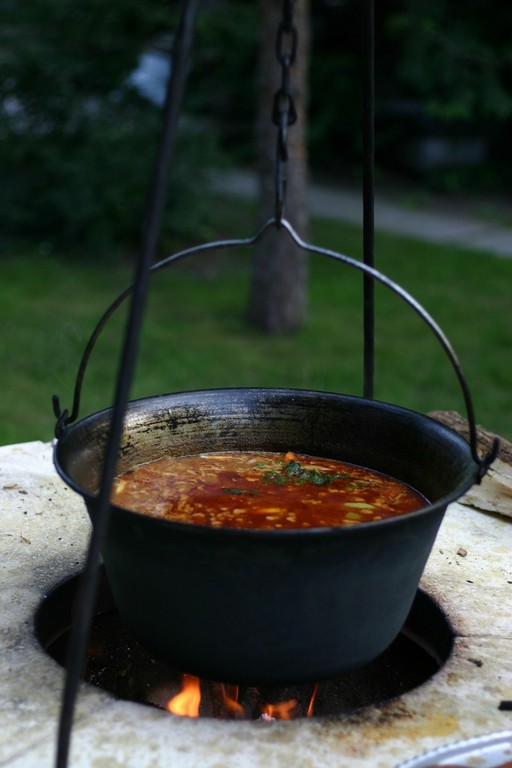
In a village at the foot of the Făgăraș Mountains, where mornings are often shrouded in mist and the houses still preserve the atmosphere of traditional mountain settlements, goulash is cooked without hurry. In a cauldron or a heavy-bottomed pot, the meat slowly becomes tender, the onions turn into a sweet and aromatic base, while paprika gives the dish its distinctive color and flavor.
Today, we step into a traditional kitchen and prepare a hearty, flavorful goulash, perfect for a family meal.
Where does goulash come from?
Goulash originated in Hungarian cuisine. The Hungarian word “gulyás” is related to “gulyá”, a term used for a cattle herder, and the dish was historically associated with food prepared by herders in cauldrons outdoors.
Over time, goulash spread throughout Central and Eastern Europe and developed numerous regional variations. In Romania, dishes inspired by the goulash tradition are found mainly in areas with Hungarian and Central European culinary influences, particularly in Transylvania.
That is why there is no single universal goulash recipe. Some versions are closer to a hearty soup, while others are thicker and resemble a stew. Beef, onions, paprika, peppers, tomatoes, potatoes and various spices may be used, depending on the region and family tradition.
Simplicity makes the difference
A good goulash does not need an endless list of ingredients. What matters is that the ingredients are fresh and that the dish is cooked slowly enough for the flavors to come together.
For 6–8 servings, you will need:
1.5 kg beef, preferably round, chuck or another cut suitable for slow cooking
approximately 800 g–1 kg yellow onions
2 red bell peppers
2–3 ripe tomatoes or approximately 250–300 g canned tomatoes
2 tablespoons sweet paprika
1 teaspoon caraway seeds
2–3 tablespoons lard or oil
2–3 cloves of garlic, to taste
salt
black pepper
approximately 700 ml–1 liter of water or beef stock, added gradually
5–6 potatoes, if you want a version with potatoes
If you want a more intense flavor, you can add a hot pepper. For a version closer to certain traditional Hungarian recipes, you can also use a little whole or ground caraway.
Red wine is not essential and is not part of the base of all traditional goulash recipes. If you choose to use it, a small amount can be added, but the dish should not become dominated by the taste of the wine.
The recipe, step by step
Step one: Prepare the meat
Cut the beef into approximately 3–4 cm cubes. Pat away any excess moisture with a paper towel and season with salt and pepper.
There is no need to marinate the meat overnight. For a well-cooked goulash, choosing a suitable cut for slow cooking and maintaining a moderate temperature are much more important.
Step two: Prepare the onions
Heat the lard or oil in a cauldron or heavy-bottomed pot.
Add the chopped onions and cook over low to medium heat, stirring occasionally, until they become soft and translucent. They should not be burnt or heavily browned.
Onions are one of the key components of goulash. Through slow cooking, they lose their sharpness and develop a natural sweetness that contributes to the consistency and flavor of the sauce.
Step three: Add the paprika
This is one of the important moments in the preparation.
Remove the pot from the heat for a few seconds and add the paprika. Stir well, then immediately add a little water or stock.
Paprika can burn very quickly, and if it is left in hot fat for too long, it can become bitter. That is why it is important to control the temperature.
Step four: Add the meat
Place the pieces of meat in the pot and stir so that they are coated with the onion and paprika mixture.
Let the meat cook for a few minutes, then add a little water or stock. There is no need for the liquid to completely cover the meat from the beginning.
Add the caraway, garlic and pepper. Stir and allow the dish to reach a gentle simmer.
Step five: The tomatoes and peppers
When the meat begins to cook, add the chopped tomatoes and sliced peppers.
The tomatoes add acidity and balance the sweetness of the onions, while the peppers contribute flavor and color.
If you use very acidic tomatoes, there is no need to add a large quantity. The goulash should have a balanced flavor, with the meat, onions and paprika remaining at the forefront.
Step six: Slow cooking
Partially cover the pot with a lid and allow the goulash to cook over low heat.
It should not boil violently. The surface of the dish should only show a gentle simmer, with small, regular bubbles.
Depending on the type and size of the meat pieces, the dish may need approximately 2.5–3.5 hours. Sometimes it may be ready sooner, while at other times it may require more time.
The important thing is to check the meat and liquid level regularly. If necessary, add small amounts of hot water or stock.
The goulash should not be allowed to dry out, but it should not be turned into a soup by adding an excessive amount of liquid either.
Step seven: The potatoes
If you choose to use potatoes, peel them and cut them into suitable pieces.
Add them during the final stage of cooking, when the meat is already almost tender. Generally, 30–45 minutes are enough for the potato pieces to cook without completely falling apart.
The potatoes absorb some of the flavors from the sauce and make the dish more substantial.
How do you know when the goulash is ready?
The best indicator is not the cooking time, but the meat.
Insert a fork into a piece. If it goes in easily and the meat is tender, without being tough or rubbery, the goulash is almost ready.
The sauce should be concentrated and flavorful. It should be neither too watery nor so thick that it resembles a paste.
If the sauce is too thin, leave the pot uncovered for a few minutes over low heat so that the excess liquid can evaporate.
If it is too thick, add a little hot water or stock and stir.
Finally, taste and adjust the salt and pepper.
How is it served?
Goulash can be served simply with fresh bread, but also alongside potatoes, dumplings or other side dishes, depending on the version being prepared.
For a rustic-style meal, homemade bread is an excellent choice, as it can be used to soak up the rich, flavorful sauce.
A simple cucumber, onion or cabbage salad can be served alongside it, as can pickles. Their acidity balances the rich flavor of the dish.
If you choose to serve wine, a dry red wine can pair well with beef goulash. Fetească Neagră is one suitable option, although the choice of wine is a matter of personal preference and is not a traditional rule of the dish.
The secret is not an ingredient
Ultimately, goulash does not need a secret ingredient.
It needs the right cut of meat, onions, good-quality paprika, spices, enough liquid and, above all, time.
It is the kind of food that does not need to be watched every second. It cooks slowly, while the flavors develop as the meat becomes tender and the sauce gradually reduces.
Perhaps that is precisely the charm of traditionally cooked dishes: they do not try to be complicated. They use simple ingredients and give them time to do their work.
Because good goulash is not just about meat, onions and paprika.
It is about time spent together, food prepared without hurry and the simple pleasure of sitting around the same table with the people you love.
And if a family recipe is passed down from generation to generation, its true value does not necessarily lie in the fact that it is a hundred years old, but in the fact that someone chose to preserve it and continue cooking it.
Do you have a family recipe that has been passed down from generation to generation?




 International editions: