


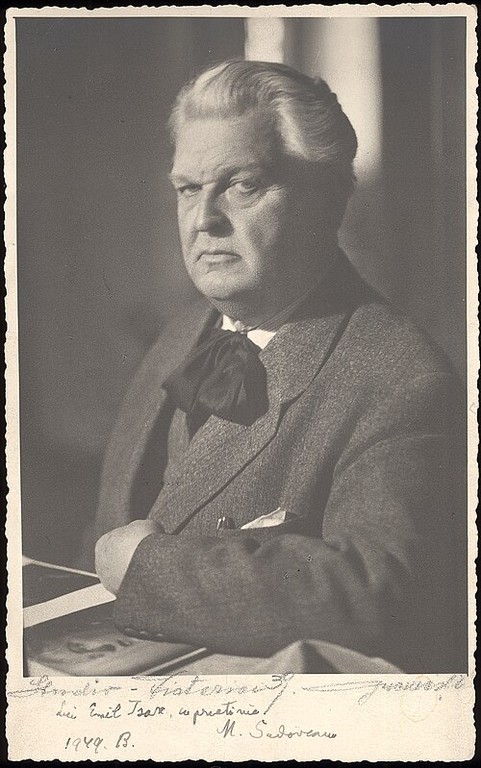
The author of "The Hatchet" (Baltagul), "The Jder Brothers" (Frații Jderi), and "The Golden Bough" (Creanga de aur), Mihail Sadoveanu left behind an impressive literary legacy inspired by Romanian history, nature, and rural life.
November 5, 2026, marks the 146th anniversary of the birth of Mihail Sadoveanu, one of the most prominent figures in 20th-century Romanian literature. A novelist, storyteller, short-story writer, and politician, Sadoveanu created an extensive body of work in which the history of Moldavia, folk traditions, the beauty of nature, and the lives of ordinary people occupy a central place.
The author of more than one hundred volumes, Mihail Sadoveanu developed a distinctive literary universe characterized by rich language, evocative descriptions, and characters deeply connected to the places they inhabit. His books contributed to the development of Romanian prose and were translated into numerous languages, introducing international readers to important aspects of Romania's culture and history.
Childhood and Early Life
Mihail Sadoveanu was born on November 5, 1880, in Pașcani, Iași County, Romania. His father, Alexandru Sadoveanu, was a lawyer, while his mother, Profira Ursachi, came from a peasant family in the village of Verșeni.
His childhood in Moldavia had a profound influence on the future writer. The landscapes, forests, rivers, customs, and stories of the people living in this region would become constant sources of inspiration throughout his literary career.
He attended primary school in Pașcani, continued his secondary education in Fălticeni, and later studied at a high school in Iași. From adolescence, he showed a strong interest in literature and began writing stories.
In 1897, he made his literary debut in the Bucharest magazine "Dracu" with the short sketch "Domnișoara M din Fălticeni", published under the pseudonym Mihai din Pașcani.
After completing high school, he enrolled at the Faculty of Law in Bucharest but eventually abandoned his studies to devote himself entirely to literature.
1904: The Beginning of a Remarkable Literary Career
A decisive moment in Mihail Sadoveanu's life came in 1904, when he published four volumes: "Povestiri" (Stories), "Șoimii" (The Falcons), "Dureri înăbușite" (Suppressed Sorrows), and "Crâșma lui Moș Precu" (Old Precu's Tavern).
The publication of four books in a single year attracted considerable attention from literary critics and readers.
The historian and literary critic Nicolae Iorga called 1904 "the Year of Sadoveanu", an expression that became associated with the remarkable beginning of his literary career.
His early writings portrayed rural communities, human relationships, social injustices, and life in Moldavia, using a narrative style that combined realism with a deep sensitivity toward nature and traditions.
In the following years, Sadoveanu continued publishing at an impressive pace, gradually becoming one of Romania's most widely recognized writers.
"Baltagul", One of Romania's Most Famous Novels
Published in 1930, "Baltagul" (The Hatchet) is considered one of Mihail Sadoveanu's most representative works.
The novel tells the story of Vitoria Lipan, a woman from a mountain village who sets out to find her husband, Nechifor Lipan, after he mysteriously disappears.
Accompanied by her son, Gheorghiță, Vitoria travels through several communities in search of the truth. Her journey becomes more than an investigation: it is also a story of maturity, justice, and respect for tradition.
The novel combines elements of detective fiction with folk mythology and a detailed portrayal of traditional pastoral communities.
Vitoria Lipan became one of the best-known female characters in Romanian literature, associated with intelligence, perseverance, and moral strength.
"Baltagul" has been included in school curricula and remains one of the books through which generations of students discover Sadoveanu's literary world.
"Frații Jderi" and His Passion for Moldavian History
The history of Moldavia was another fundamental theme in Sadoveanu's literary work.
One of his most significant achievements is the historical trilogy "Frații Jderi" (The Jder Brothers), consisting of "Ucenicia lui Ionuț" (Ionuț's Apprenticeship, 1935), "Izvorul Alb" (The White Spring, 1936), and "Oamenii Măriei Sale" (His Majesty's Men, 1942).
The story takes place during the reign of Stephen the Great, one of the central figures of medieval Romanian history.
Through the Jder family, Sadoveanu recreates the atmosphere of medieval Moldavia, life at the princely court, military conflicts, social relationships, and the values of the period.
Stephen the Great is portrayed as a ruler concerned with defending and organizing his country, while the surrounding characters offer insights into everyday life and the mentality of the era.
The trilogy combines historical events with literary fiction, presenting a broad picture of 15th-century Moldavia.
"Hanu Ancuței": The Art of Storytelling and Oral Tradition
Published in 1928, "Hanu Ancuței" (Ancuța's Inn) is one of Mihail Sadoveanu's most highly regarded literary creations.
The book brings together nine stories told by characters who gather at a traditional Moldavian inn, in an atmosphere filled with memories, unusual events, and recollections of the past.
Each storyteller shares a different experience, and together their narratives create a world in which reality intertwines with legend.
Through this structure, Sadoveanu celebrates the oral storytelling tradition characteristic of Romanian rural communities.
Archaic language, popular expressions, and atmospheric descriptions contribute to the charm of the collection, which is considered an important example of Romanian narrative art.
Nature, a Constant Presence in His Writing
One of the distinctive features of Mihail Sadoveanu's work is the profound connection between people and nature.
Forests, mountains, rivers, and plains are not merely settings; they help shape the atmosphere and define the characters.
Sadoveanu was passionate about fishing, hunting, and exploring the natural world. He spent considerable time in the forested regions of Moldavia and the Danube Delta, places that inspired many of his literary descriptions.
In volumes such as "Țara de dincolo de negură" (The Land Beyond the Mist) and "Împărăția apelor" (The Kingdom of Waters), the writer describes landscapes, wildlife, traditions, and experiences in the heart of nature.
His descriptions highlight both the beauty of Romania's landscapes and the relationship between traditional communities and their natural environment.
"Creanga de aur": Between History, Myth, and Spirituality
Published in 1933, "Creanga de aur" (The Golden Bough) occupies a special place in Sadoveanu's literary career.
The novel is set in a world inspired by the distant past of the Carpathian-Danubian region and the Byzantine Empire.
The central character, Kesarion Breb, is a wise man initiated into the spiritual traditions of ancient Dacia who travels to Constantinople.
The novel explores themes such as knowledge, faith, love, power, and the relationship between the material and spiritual worlds.
Through its symbols and cultural references, "Creanga de aur" differs from the author's realist novels and demonstrates the diversity of his literary interests.
Literary Recognition and Cultural Activities
In addition to his work as a writer, Mihail Sadoveanu held numerous positions in Romania's cultural institutions.
He served as director of the National Theatre in Iași, becoming involved in the organization of theatrical life and the promotion of Romanian culture.
In 1916, he became a corresponding member of the Romanian Academy, and in 1921, he was elected a full member. He later held leadership positions within the institution.
In 1938, the University of Iași awarded him an honorary doctorate in recognition of his contribution to national literature and culture.
His literary reputation extended beyond Romania's borders. His works were translated into numerous languages, while his historical novels and stories inspired by rural life introduced international audiences to Romanian traditions and landscapes.
Political Activity and the Controversies of His Later Years
Mihail Sadoveanu's biography cannot be separated from his political activity, particularly in the period following the Second World War.
Throughout his life, the writer was involved in several political organizations and held parliamentary positions. Between 1931 and 1932, he served as President of the Romanian Senate.
After the war, he became increasingly close to the new communist authorities and emerged as one of the prominent intellectuals who publicly supported the regime.
Between 1946 and 1948, he presided over the Assembly of Deputies. Following the proclamation of the Romanian People's Republic, he occupied important positions within the country's political institutions.
His association with the communist regime generated controversies that continue to influence historical assessments of his life.
The novel "Mitrea Cocor", published in 1949, reflects the ideological orientation of the period, presenting the transformation of rural society from a perspective favorable to the new regime.
Therefore, when examining his biography, it is important to distinguish between his literary contribution, recognized for its artistic value, and the political choices he made during the final decades of his life.
Personal Life and His Connection to Moldavia
Throughout his life, Mihail Sadoveanu maintained a profound connection with Moldavia, the region where he was born and which inspired much of his writing.
In 1901, he married Ecaterina Bâlu, with whom he had eleven children. Following the death of his first wife, he married Valeria Mitru.
Between 1919 and 1936, he lived in a house in Iași that would later become a memorial museum.
Another residence associated with his name is located in Vânători-Neamț, near Neamț Monastery. Here, the writer spent important periods of his life surrounded by a natural environment similar to the landscapes described in many of his books.
Today, the places connected to Sadoveanu's life are destinations of cultural interest for those wishing to discover both the author's biography and Moldavia's historical and literary heritage.
Death and Literary Legacy
Mihail Sadoveanu died on October 19, 1961, in Bucharest, at the age of 80.
He was buried in Bellu Cemetery, the final resting place of numerous prominent figures in Romanian culture and history.
He left behind an impressive literary legacy consisting of novels, novellas, short stories, memoirs, and translations.
Over the years, schools, libraries, streets, and cultural institutions have been named after him, while some of the houses in which he lived have become museums dedicated to preserving his memory.
His books continue to be studied in schools and universities, and novels such as "Baltagul", "Frații Jderi", and "Creanga de aur" occupy an important place in the history of Romanian literature.
His legacy remains complex: on the one hand, an extensive literary achievement that helped preserve traditions and historical memory; on the other, a political career that continues to generate debate.
On the 146th anniversary of his birth, Mihail Sadoveanu remains one of the authors through whom readers can discover traditional Romanian village life, the history of Moldavia, and the richness of Romanian folk traditions. His work forms an important part of Romania's literary heritage and continues to be read and studied by new generations.





 International editions: