


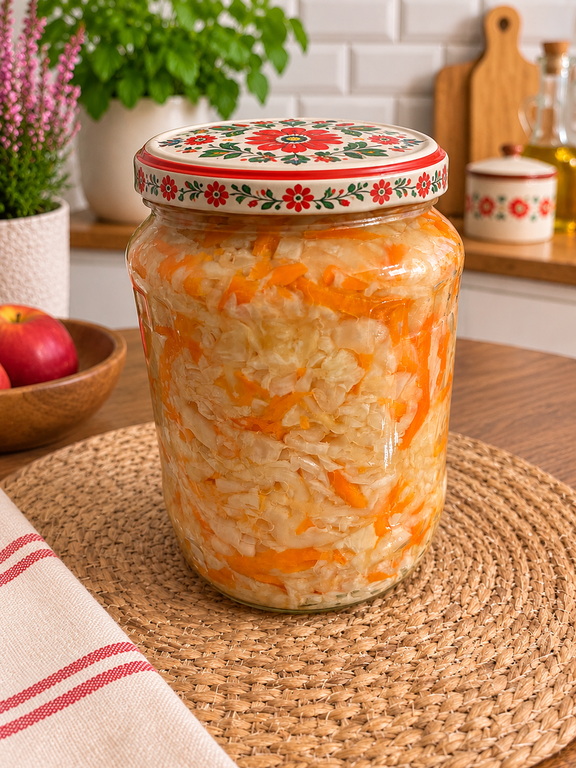
Sauerkraut with carrots is one of the most popular traditional dishes of the colder months. Crunchy, pleasantly tangy, and flavorful, it can be served alongside a wide variety of meals, from potatoes and roasted meats to bean dishes and other home-cooked specialties.
Preparing it at home requires no complicated ingredients, but following a few important rules is essential. Choosing fresh cabbage, using the correct amount of salt, and keeping the vegetables submerged in their own brine are key to successful fermentation.
Unlike cabbage salads preserved with vinegar, traditional sauerkraut develops its characteristic flavor through lactic acid fermentation, a natural process in which lactic acid bacteria convert the sugars found in vegetables into lactic acid.
Fermenting vegetables is one of the oldest methods of food preservation. Before refrigerators became common, people relied on salt and fermentation to preserve vegetables for longer periods, particularly during winter.
Fermented cabbage is found in many culinary traditions across Central and Eastern Europe, including Romania and the Republic of Moldova.
In Romanian households, cabbage is traditionally fermented both as whole heads in large barrels, especially for preparing stuffed cabbage rolls, and finely shredded, sometimes combined with carrots and spices.
The carrot version is particularly appreciated for its balanced flavor and attractive color. Carrots add a subtle sweetness that complements the natural acidity of fermented cabbage.
Ingredients for Homemade Sauerkraut with Carrots
For approximately two 1-liter jars, depending on how tightly the vegetables are packed:
1.5 kg white cabbage, with damaged outer leaves removed
300 g carrots
36 g non-iodized pickling salt, representing 2% of the total vegetable weight
1 teaspoon caraway seeds, optional
A few black peppercorns, optional
1-2 bay leaves, optional
You will also need a large mixing bowl, two clean glass jars, food-safe fermentation weights, and suitable lids, preferably fitted with fermentation airlocks.
There is no need to add vinegar, sugar, or preservatives.
Step-by-Step Preparation
1. Prepare the Cabbage
Remove any damaged outer leaves from the cabbage, then cut the head into halves or quarters.
Remove the tough core and finely shred the cabbage using a sharp knife or a cabbage slicer.
The more evenly the cabbage is shredded, the more consistently it will ferment.
Set aside one or two clean cabbage leaves, which can later be used to help keep the shredded vegetables submerged beneath the brine.
2. Prepare the Carrots
Wash and peel the carrots, then grate them using the large holes of a grater.
Add the grated carrots to the shredded cabbage in a large bowl and mix thoroughly to distribute them evenly.
3. Add the Salt
Weigh the prepared vegetables and add salt equal to 2% of their total weight.
For 1.8 kg of vegetables, you will need 36 g of salt.
Sprinkle the salt over the cabbage and carrots, then mix well.
Allow the mixture to rest for approximately 15-20 minutes. During this time, the salt will begin drawing moisture out of the vegetables.
4. Massage the Vegetables
Once the vegetables begin to soften, massage and squeeze them with clean hands for approximately 5-10 minutes.
Gradually, the cabbage will release the liquid needed for fermentation.
This liquid forms the natural brine in which the vegetables must remain submerged.
At this stage, add the caraway seeds, peppercorns, or bay leaves, if desired.
5. Fill the Jars
Transfer the vegetables into clean jars, adding small portions at a time.
Press each layer firmly with a spoon or suitable utensil to remove trapped air and encourage the brine to rise to the surface.
Pour any remaining liquid from the bowl over the vegetables.
Place a cabbage leaf on top, followed by a food-safe fermentation weight, to keep all the vegetables below the brine.
Leave several centimeters of space at the top of each jar, as fermentation produces gases and may cause the liquid level to rise.
If the natural brine does not completely cover the vegetables, you can add a small amount of brine prepared with 20 g of salt per liter of drinking water.
6. Allow the Vegetables to Ferment
Place the jars on a tray in a location away from direct sunlight, at a moderate temperature, ideally around 18-22°C (64-72°F).
Use lids fitted with fermentation airlocks, which allow gases to escape. If using ordinary lids, do not seal them tightly without a way for gases to escape. Open them carefully and periodically to release pressure.
During the first few days, gas bubbles may appear, and the brine may become slightly cloudy. These are normal signs of lactic acid fermentation.
Check daily to ensure that the vegetables remain completely submerged beneath the brine.
Do not taste directly from the jar using a previously used spoon, and avoid introducing dirty utensils.
7. When Is the Sauerkraut Ready?
Fermentation time depends on room temperature, salt concentration, and the characteristics of the vegetables.
At approximately 18-22°C (64-72°F), the cabbage may begin developing a tangy flavor after a few days, but a more pronounced acidity generally takes two to four weeks.
For safer fermentation, it is advisable to monitor acidity using food-appropriate pH test strips or a pH meter. The fermented product should reach a pH of 4.6 or lower, with a lower pH providing an additional safety margin.
The sauerkraut should have a pleasant, tangy aroma characteristic of fermentation and retain a relatively crunchy texture.
If fuzzy mold, a rotten smell, or an unusually slimy consistency develops, discard the entire batch. Simply removing the affected layer is not sufficient.
Once fermentation is complete, close the jars and transfer them to the refrigerator, keeping them at a temperature of 4°C (40°F) or below.
Keep the vegetables covered with brine and always use clean utensils when removing a portion.
This recipe is intended for refrigerated storage, not long-term storage at room temperature. Preserving sauerkraut without refrigeration requires validated heat-processing procedures.
Choosing good-quality ingredients and following the correct proportions are essential for achieving the best results.
Use fresh, firm, healthy cabbage without damaged areas. The carrots should also be fresh.
Weigh the salt rather than measuring it with a spoon, as differences in grain size can affect the actual amount used.
Do not arbitrarily reduce the salt concentration. Salt helps extract moisture, maintain texture, and create favorable conditions for lactic acid fermentation.
Keep the vegetables submerged throughout the fermentation process and avoid excessively high temperatures, which can affect their texture and quality.
For a more aromatic flavor, add caraway seeds or a few peppercorns without changing the salt ratio.
Sauerkraut with carrots is extremely versatile and can accompany a wide variety of dishes.
It can be served as a salad with a little oil and, if desired, finely chopped onion. It pairs particularly well with baked or boiled potatoes, roast pork, bean dishes, and traditional winter meals.
It can also be used as an ingredient in cooked recipes, although heating destroys many of the live microorganisms present in fermented vegetables.
Cabbage is a source of dietary fiber and contains vitamins and minerals. During fermentation, its flavor and certain characteristics change due to the activity of lactic acid bacteria.
Unpasteurized sauerkraut may contain live microorganisms, although their types and quantities vary. Not all fermented foods can automatically be considered probiotics with clinically proven health benefits.
Sauerkraut also contains a significant amount of salt, so people who need to limit their sodium intake should be mindful of portion sizes.
Sauerkraut with carrots demonstrates that some of the most appreciated traditional foods can be made with very few ingredients.
Fresh cabbage, carrots, and salt, combined with patience and the right fermentation conditions, transform into a flavorful side dish suitable for many different meals.
Preparing sauerkraut at home allows you to control the ingredients, customize the seasonings, and preserve a culinary tradition passed down through generations.
Whether served alongside a traditional meal or enjoyed as a salad, homemade sauerkraut with carrots remains a simple, affordable, and much-loved part of Romanian cuisine.





 International editions: