


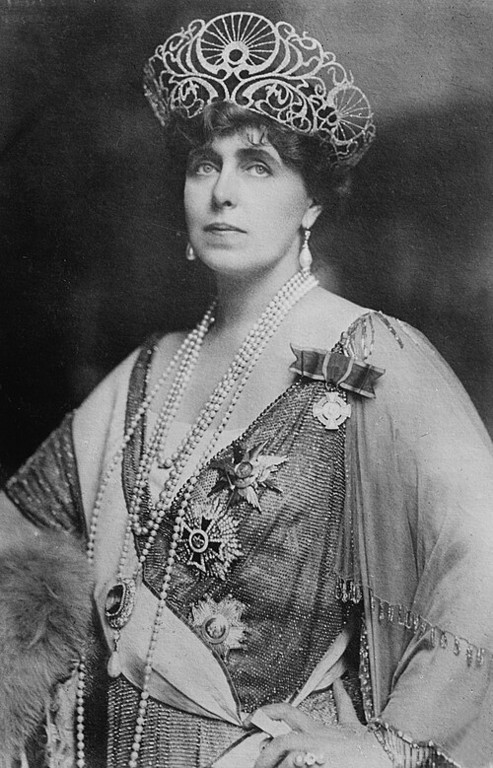
Born on October 29, 1875, in Britain, Marie was the daughter of Prince Alfred, Duke of Edinburgh, son of Queen Victoria, and Grand Duchess Maria Alexandrovna of Russia. In January 1893, she arrived in Bucharest following her marriage to Prince Ferdinand, heir to the Romanian throne.
Marie gradually became much more than a ceremonial figure. She was known for her energy, courage and involvement in social and humanitarian activities. During the Second Balkan War and, later, the First World War, she played an active role in supporting the Romanian Red Cross, visiting hospitals and encouraging medical teams and wounded soldiers.
In 1914, following the death of King Carol I, Ferdinand became King of Romania and Marie became Queen. One of the most significant moments of her public life came on October 15, 1922, when she and King Ferdinand were crowned at Alba Iulia, in a ceremony that symbolized the newly unified Romanian state.
Queen Marie's influence extended well beyond politics. She was deeply interested in art, literature, architecture, photography and interior design. She wrote numerous books, including children's stories and autobiographical works. Her memoirs, The Story of My Life, remain among her best-known writings.
Her legacy can still be discovered through the historic residences associated with her life. Peleș Castle and, particularly, Pelișor Castle in Sinaia were among the royal family's most important residences. Built between 1899 and 1902 for Ferdinand and Marie, Pelișor became closely associated with the Queen's personal style. She was involved in the decoration of its interiors, creating spaces characterized by an original combination of Art Nouveau influences, Romanian motifs and elements inspired by nature.
Another important place connected with Queen Marie is Bran Castle. After it was presented to her in 1920 by the city of Brașov, the Queen undertook restoration and renovation work and transformed the castle into one of her favorite residences. Its rooms and gardens became part of the personal world she created around herself and her family.
Queen Marie was also deeply attached to Balchik, then part of Romania. On the Black Sea coast, she created a private retreat known as the "Quiet Nest", surrounded by gardens and featuring the Stella Maris chapel. The complex became one of the places closest to the Queen's heart and remains an important part of her cultural legacy.
Bucharest also preserves important traces of Queen Marie's life. Cotroceni Palace became the residence of Crown Prince Ferdinand and Princess Marie before they ascended the throne. The royal couple had six children: Carol, Elisabeth, Marie, Nicholas, Ileana and Mircea.
Queen Marie was also an important international representative of Romania. In 1926, she travelled to the United States, where her public appearances attracted considerable attention and helped promote Romania's image abroad.
Queen Marie died on July 18, 1938, at Pelișor Castle. She was buried at Curtea de Argeș Monastery, alongside other members of the Romanian royal family.
Today, Queen Marie's legacy can be explored through a cultural route connecting Bucharest, Sinaia and Bran, as well as through the history of Balchik. These places reveal different aspects of her personality: the queen, diplomat, writer, patron of the arts and passionate creator of gardens and interiors.
More than eight decades after her death, Queen Marie remains a distinctive figure in Romanian history. Her residences, writings, gardens and personal objects continue to tell the story of a woman who became deeply connected to Romania and whose image remains closely associated with the country's cultural heritage.



 International editions: