


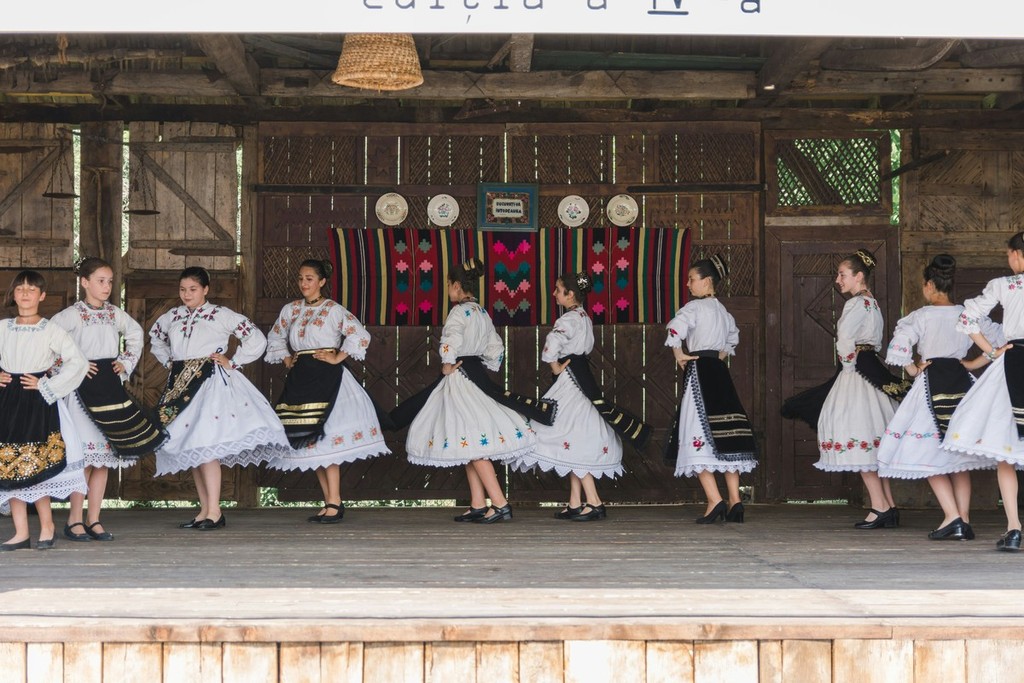
Romania has numerous traditional costume styles, with each region developing its own cuts, colour combinations and decorative motifs. A traditional costume from Maramureș can look very different from one from Bucovina, Transylvania, Oltenia or Banat, and differences can sometimes be observed even between neighbouring communities.
One of the most important pieces of women’s traditional clothing is the ie, the Romanian traditional blouse. Made from woven fabric and decorated by hand, the ie can feature geometric, floral or plant-inspired motifs. These are often arranged on the sleeves, chest and around the neckline.
Geometric motifs are among the oldest decorative elements found in Romanian traditional clothing. Lines, diamonds, crosses, zigzags and other repeated shapes can create complex compositions in which symmetry and rhythm play an important role.
Floral and botanical motifs are also widespread. Flowers, leaves, branches and other forms inspired by nature appear on many traditional garments. These representations are connected with the natural environment surrounding rural communities and with the important role that nature played in traditional life.
Representations of birds and other animals can also be found in traditional ornamentation. Depending on the region and local traditions, these motifs may appear in stylised forms and be incorporated into geometric or floral compositions.
Colours also play an important role. Red, black, white, blue, yellow and green appear in different combinations, although the choice of colours varies according to region, age, occasion and local tradition. In some areas, particular colours are more dominant than others, helping to identify a specific regional style.
The traditional costume consists of much more than the ie. Depending on the region, it can include skirts, aprons, woven belts, head coverings, waistcoats, sheepskin coats and other distinctive garments. Each piece may have its own motifs and decorative techniques.
In Transylvania, for example, traditional clothing reflects the cultural diversity of the region. Romanian, Hungarian and Saxon communities developed different customs and influences, and traditional dress can vary considerably from one locality to another.
In Bucovina, traditional costumes are known for their rich ornamentation and the variety of geometric and floral motifs. In some communities, traditional embroidery and decorative techniques are still preserved and passed on to younger generations.
In Maramureș, traditional clothing stands out through its distinctive cuts, materials and colour combinations. The blouse, skirt, belt and outer garments form an ensemble that can reveal the local origin of the person wearing it.
In Oltenia and other regions of southern Romania, embroidered motifs on blouses and other garments also display strong regional characteristics. Geometric and botanical motifs are frequently encountered, while the colour palette can vary from one community to another.
An important aspect of traditional clothing is that it could communicate information about the person wearing it. In some communities, differences in dress could indicate regional origin, social status, age or marital status, as well as the occasion for which the costume was worn.
Festive costumes were generally more richly decorated than garments intended for everyday activities. Clothing worn for weddings, religious celebrations and other important community occasions could feature elaborate embroidery and carefully selected fabrics and ornaments.
Today, Romanian traditional costumes can be seen both in rural communities and at festivals, cultural events, folk performances and celebrations dedicated to traditional heritage. Craftspeople and artisans continue to make certain garments by hand, preserving sewing and embroidery techniques passed down through generations.
More than simply clothing, the traditional costume represents a form of cultural expression. The embroidered motifs, fabrics, colours and ways in which the individual pieces are combined preserve information about the places where they were created and the communities that have passed them down.
Seen today, the Romanian traditional costume therefore offers a visual map of the country’s cultural diversity. Each region, each community and sometimes even individual families may preserve their own distinctive features, making traditional dress an important part of Romania’s cultural memory.



 International editions: