


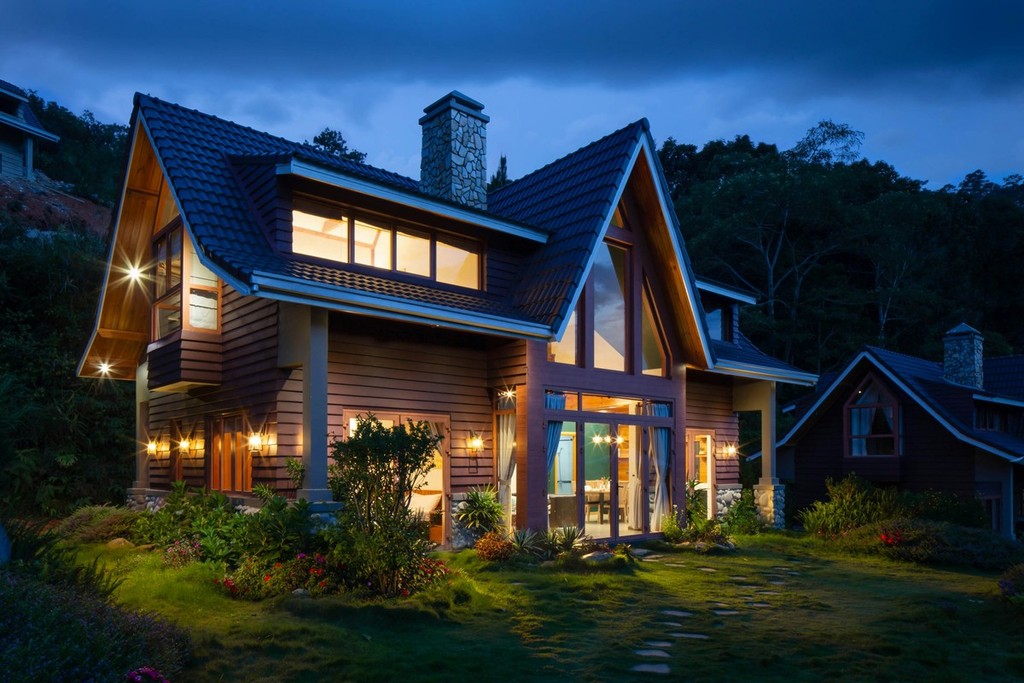
But they do have a comfortable bed, a crackling wood-burning stove, a porch overlooking the mountains and, above all, silence.
That authentic silence that seems almost nonexistent in cities today, whose sound you have nearly forgotten and which, if you listen carefully, you begin to experience almost as a form of healing.
In recent years, more and more people have chosen to escape the hustle and bustle of the city and seek refuge in eco-friendly cabins hidden in forests or on isolated hills. They are no longer necessarily looking for a five-star hotel, but for an authentic experience, a return to the essentials. No notifications, no emails, no screens glowing in the darkness. Just themselves, nature and time finally slowing down.
What does staying in an eco-friendly cabin actually mean?
It is not simply a wooden building located in a picturesque setting. It is also a philosophy. It means using natural materials, reducing the carbon footprint, relying on renewable energy, managing water responsibly and, above all, integrating harmoniously into the landscape.
The walls are thick, the insulation may be made from sheep’s wool or cork, while the large windows allow sunlight to flood in from the early morning hours and keep the surrounding landscape constantly in view.
The cabins are small, but intelligently designed. A living room with a wood-burning stove or fireplace, a simple and functional kitchen, a bedroom with a large bed and, almost always, a covered porch. Some even have a hot tub or an outdoor wooden tub filled with warm water, where you can relax in the evening while looking up at the star-filled sky.
Many of these places, however, have one feature in common: the intentional absence of technology. No screens, no router, no cables. The hosts tell you from the very beginning: there is no signal here.
If you want to call home, you have to walk up the hill until you find a spot where you can get two bars. If you need internet, you may have to go to the cabin down in the valley, several kilometres away. Otherwise, you simply enjoy what is in front of you: the forest, the sky, the rustling leaves, the birdsong and perhaps a spring flowing somewhere nearby.
Romania is full of places like these.
In the Apuseni Mountains, there are cabins hidden in clearings, accessible only by dirt roads, where the night is so dark that you feel as if you have stepped into a painting. Here, the only light may come from an oil lamp or from the fire burning in the stove.
In the morning, you wake to the sunlight filtering through the curtains and the scent of the wet forest. You step outside barefoot, feel the cool grass beneath your feet and drink a cup of herbal tea made from plants gathered in the surrounding meadows, while the mist slowly rises from the valleys.
In Maramureș, the cabins can have an even more traditional character. Walls made of hand-assembled logs, shingle roofs and wooden gates carved by local craftsmen. Here, you find not only silence, but also the feeling of being in a world that still follows the rhythms of nature.
In the yard, chickens wander around, and fresh milk may appear on the breakfast table in the form of locally made cheese. In summer, you can sleep with the window open, while in winter you wrap yourself in thick wool blankets as the fire crackles in the stove and the wind blows outside.
In the Bran-Moieciu area, eco-friendly cabins are often more modern, but just as secluded. Some are built on mountain slopes, with views towards the Bucegi or Piatra Craiului Mountains. From the terrace, you can watch the clouds slowly drift over the peaks. If you are lucky, you may even spot a bird of prey gliding in wide circles above the valleys.
A day spent in a cabin like this has nothing to do with an ordinary day.
You wake up without an alarm, in the morning light. In front of the house, a wooden table and two chairs are waiting for you to enjoy your breakfast in silence. You have no urgent thoughts, no unfinished tasks and no fear that you have missed an important message.
You set off along a trail known to the locals, walk through a beech forest and listen to the leaves rustling beneath your feet. The bells around the sheep’s necks can be heard in the distance, and sometimes you meet a shepherd who greets you and offers you a glass of fresh milk.
You return at lunchtime and prepare something simple. Perhaps polenta with cheese, or some vegetables bought in the nearby village. You eat slowly, without rushing, looking through the window as a squirrel climbs down from a tree in search of hazelnuts.
In the afternoon, if it is warm, you settle into a hammock and read a book you have been putting off for months. Or perhaps you read nothing at all. You simply stay there with your eyes closed, feeling the sun warming your face.
Evening approaches, and you light the fire.
There is nothing simpler and, at the same time, more profound than sitting beside a fire, watching the flames rise and saying nothing. Or talking about whatever comes to mind.
Fire has something almost hypnotic about it. It gives you time to stop, reflect and simply be present. Beneath a sky full of stars, with no trace of artificial light on the horizon, you realise that you have not missed anything all day. Not even your phone.
What do you actually gain when you completely disconnect?
The answer is simple: time.
Not chronological time, measured in minutes and hours, but the kind of time in which you can actually feel every second.
In the city, days pass without you really noticing them, consumed by phones, appointments, traffic and endless to-do lists. In a cabin surrounded by nature, away from technology, the day seems to have another dimension.
You have time to finish your coffee down to the last drop. You have time to listen to a bird for several minutes, observe its feathers and follow its flight. You have time to feel hungry before you eat, to watch the light change from hour to hour, to breathe deeply and feel the air filling your lungs.
You also realise that you do not need so many things. A warm meal, a roof over your head, an honest conversation or a few hours of peaceful solitude. The rest is sometimes just noise.
Disconnecting from your phone and from the constant flow of notifications can help reduce feelings of overload and encourage relaxation and better sleep. But you do not always need studies to understand the effect of such a break. You can feel it yourself: the tension begins to disappear, the body relaxes and the mind becomes clearer.
After a weekend without technology, you can return home calmer, more present and more grateful.
There are, however, a few things to keep in mind before setting off on an experience like this.
First of all, be prepared to spend time with yourself. No distractions, no scrolling, no music in the background. If you are not used to silence, the first few hours may feel difficult. But give it time. After a few hours, you will discover that your mind begins to calm down and your thoughts no longer race quite so quickly.
Secondly, stock up wisely. Bring food, water, a lighter and a flashlight. Eco-friendly cabins are generally well equipped, but do not expect to find a supermarket around the corner.
Bring a book, a journal, perhaps even a canvas and some watercolours. You will have plenty of free time.
Do not forget to let someone know where you are going, especially if there is no phone signal. Leave a friend or family member a message with the exact location and the estimated duration of your stay. It is a simple safety precaution.
And, most importantly, leave your phone in your bag. Do not take it out. Do not check it. The world can wait.
What remains after an experience like this?
A memory that does not fade quickly remains within you. So does the habit of looking at the sky more often, feeling the breeze on your skin and appreciating silence. And there is a desire to repeat the experience, to find more and more time for peace and quiet.
Perhaps you will change something in your everyday life. Maybe you will stop using your phone an hour earlier in the evening, or go to the park more often simply to sit on a bench. Or perhaps you will start saying “no” more often to invitations or commitments that bring you no joy.
Because once you have tasted true silence, it becomes easier to seek it in everyday life as well.
Disconnecting is not something you do only for a weekend. It can become a way of life.
If you feel that you need a break, if the noise of everyday life is suffocating you, if screens seem increasingly empty, look for an eco-friendly cabin without Wi-Fi.
Turn off your phone. Light the fire. Sit in silence. Listen to the rustling trees and the sound of the stream flowing downhill. Watch how the shadow moves across the floor as the sun slowly sets. Taste the simple food and enjoy the company of yourself or the people you love, without interruptions.
You do not have to be a monk. You do not have to meditate for hours or practise yoga in complicated poses. You simply have to be there, with yourself, for a moment.
To remember that the world keeps moving even without you. And that there is nothing wrong with stepping aside for a few days and simply watching it go by.
Because, at the end of the day, the most beautiful things cannot be found on screens.
They are felt in the soul.






 International editions: