


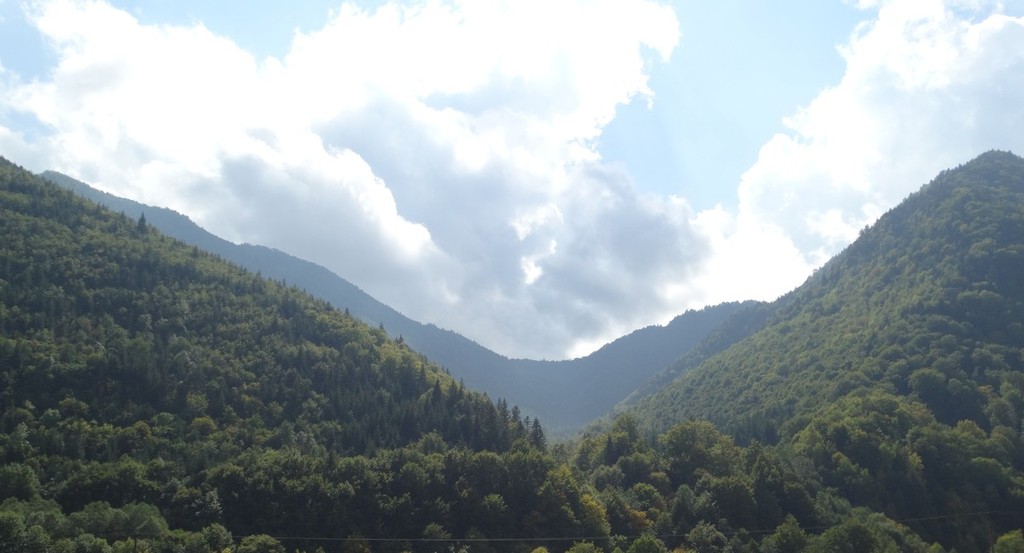
Much of the mountain area is included in Putna-Vrancea Natural Park, one of the main protected natural areas in Vrancea County.
Putna-Vrancea Natural Park covers 38,204 hectares and represents approximately 41% of the mountainous area of Vrancea County. The protected area includes important sectors of the Vrancea Mountains, including the Lăcăuți-Goru Mountains, Mount Coza, the Lepșa area and Zboina Neagră.
Among the best-known points of interest are the Tișița Gorges Nature Reserve, Putna Waterfall, Mount Goru, Lake Negru in the Năruja Gorges, the Zăbala Potholes and Groapa cu Pini. These natural attractions offer different perspectives on the mountain landscape and can be included in excursions and hikes of varying levels of difficulty.
Tișița Gorges, one of the main attractions of the Vrancea Mountains
One of the best-known routes crosses the Tișița Gorges Nature Reserve. The main trail starts at Gura Tișiței and continues for approximately seven kilometres upstream, reaching the Great Tunnel. The route is marked with a red triangle and has an elevation gain of approximately 200 metres. The main section, there and back, takes around four to six hours, depending on each hiker’s pace and level of fitness.
Along the way, hikers encounter several natural and historical landmarks, including La Tuburi, La Pârâul Arșiței, La Bolovan, La Pândar, Arcada 1 and 2 and the Great Tunnel. The area also preserves traces of former forestry infrastructure, with part of the trail following a forest road built on the site of a former forestry railway.
For those choosing this route, mountain rescue services recommend staying exclusively on the marked trail, wearing footwear with good grip and checking the trail conditions and weather forecast beforehand. Certain sections present a risk of falling rocks, while during winter the route is closed because of avalanche risks.
Putna Waterfall, a landmark of the mountain area
Not far from the Tișița Gorges lies Putna Waterfall, located in the territory of Tulnici commune, near the village of Lepșa. The waterfall is a nationally protected natural area and is part of Putna-Vrancea Natural Park.
The waterfall follows a riverbed shaped by erosion, creating a succession of drops and natural steps before reaching a lake. The waterfall is approximately 76 metres long, with an elevation difference of 14 metres, while the lake at its base reaches a depth of approximately 12 metres. Putna Waterfall was declared a Natural Monument in 1973.
Hiking routes for mountain enthusiasts
The Vrancea Mountains have an extensive network of marked tourist trails, allowing visitors to explore very different parts of the mountain range. Important routes include Tulnici – Mount Coza – Tișița Saddle – Zboina Frumoasă – Nereju; Lepșa – Tișița Gorges – Cristianu Stream – Geamăna Saddle; and Poiana Șindrilita – Zăbăluța Valley – Mârdanu – Lăcăuți Peak.
For experienced hikers, the area also provides access to some of the highest peaks in the Vrancea Mountains. One example is the route between Lăcăuți Peak and Goru Peak, continuing towards Goru Stream and the Zăbala Valley. The route is classified as moderate and is marked with a blue cross.
Goru Peak, at an altitude of 1,785 metres, is the highest point in the Vrancea Mountains. The surrounding area is notable for its high degree of naturalness and for the presence of important forest and subalpine habitats. The Goru Nature Reserve is included in the strict protection zone of Putna-Vrancea Natural Park.
The Vrancea Mountains, a destination for every season
The mountain landscapes of Vrancea can be explored along trails starting from localities and access points such as Lepșa, Tulnici and Greșu. From walks near natural attractions to ridge crossings and ascents towards mountain peaks, the area offers experiences suited to different levels of hiking ability.
Beyond the mountain trails, Vrancea County also offers cultural and historical attractions that complement the outdoor experience. The memorials at Mărăști, Mărășești and Soveja, the “Moș Ion Roată” Memorial House in Câmpuri and Tudora Vrâncioaia House in Bârsești are among the landmarks that contribute to the cultural and historical identity of the county.
The Vrancea Mountains are therefore a destination where nature and local heritage meet in a territory well suited to hiking, exploration and outdoor tourism. For a safe experience, visitors are encouraged to choose trails according to their level of fitness and experience, check weather conditions and trail status in advance, and respect the regulations applicable within protected natural areas.




 International editions: