


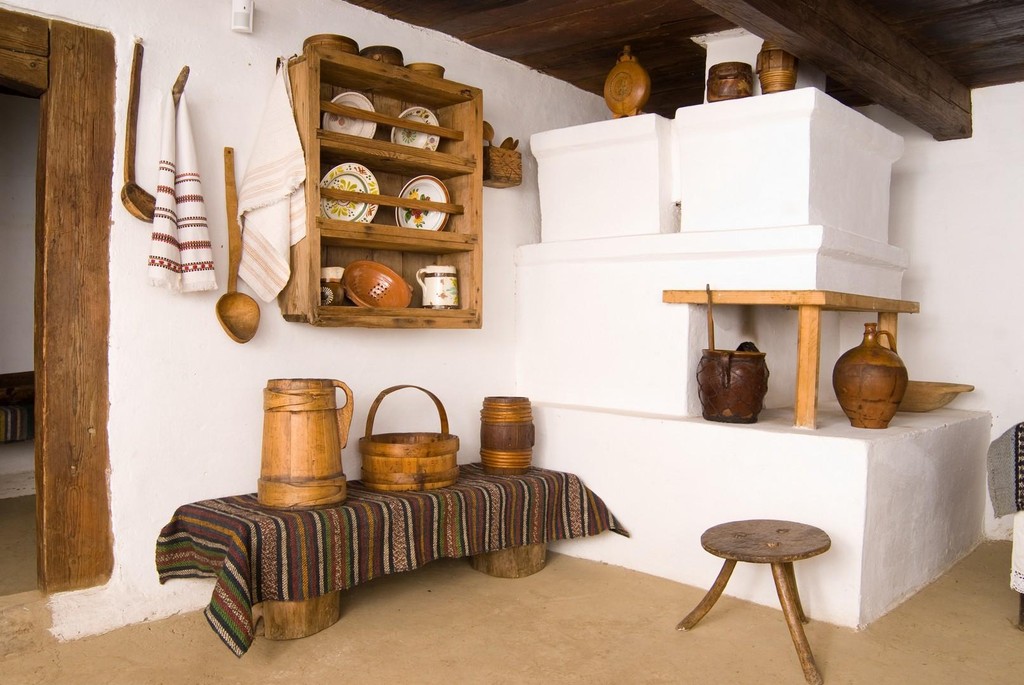
It was where the family’s food was prepared, provisions were stored and many everyday activities took place. The appearance of a kitchen varied from one region to another, as well as according to the type of house and the resources available, but traditional kitchens generally shared the same principles of simplicity, practicality and careful use of household resources.
In many rural homes, the kitchen was organised around the hearth or stove. Fire was the main source of heat and was essential for cooking. Depending on the region and the type of dwelling, households could have open hearths, bread ovens or different types of traditional stoves.
The hearth was more than simply a place for cooking. It was often at the centre of family life. Soups, stews, polenta, bread and many other dishes were prepared around the fire, using ingredients that often came from the household itself or from the surrounding community.
Kitchen utensils were generally simple and durable. Earthenware pots, cast-iron or metal cooking vessels, wooden spoons, sieves, wooden troughs and other wooden implements could be found in many households. Each object had a specific purpose and was usually kept and used for many years.
In many parts of Romania, traditional pottery played an important role in the kitchen. Earthenware pots could be used for cooking over the fire, while other ceramic vessels served to store food. Traditional pottery varied considerably between regions, both in shape and decoration.
Food storage was another important aspect of household life. Grains, flour, cornmeal, beans, onions, garlic, potatoes, dried fruit and other products were stored in ways designed to preserve them for the months ahead.
Meat and products obtained from the traditional winter pig slaughter were also preserved using methods such as smoking, salting and drying. These techniques were particularly important at a time when modern refrigeration was not available to most rural households.
Bread was a staple food in many regions of Romania. In households with a bread oven, dough was prepared by hand and loaves were baked according to the needs of the family. In many areas, polenta also played an important role in the daily diet.
The ingredients used in traditional kitchens were largely local and seasonal. Vegetables from the garden, grains grown near the household, milk, eggs, cheese, meat and fruit formed the basis of a diet adapted to the resources available in each region.
Preparations for winter often began during summer and autumn. Vegetables and fruit were transformed into preserves, pickles, jams and compotes. Some foods were dried, while grains and other provisions were carefully stored for the cold months.
The traditional kitchen was therefore closely connected to the agricultural calendar. Each season brought different ingredients and different household tasks. Spring marked the beginning of garden work, summer brought the first harvests, autumn was the season of gathering and preserving, while winter was largely a time for consuming the provisions prepared during the preceding months.
In many households, women played a central role in preparing food and preserving provisions, while other activities, such as slaughtering the household pig, preparing firewood or carrying out agricultural work, frequently involved the wider family and sometimes the community.
Traditional cooking was not defined by modern appliances or a large collection of specialised utensils. Instead, it depended on the skill of the person preparing the food and on the household’s ability to make the most of what it produced. Food waste was limited, and ingredients were often reused in other preparations.
Today, many of these practices have disappeared or changed considerably. Nevertheless, traditional utensils, bread ovens, pottery and old preservation techniques can still be found in some villages and households, either as part of everyday life or as elements of Romania’s cultural heritage.
A Romanian kitchen of a century ago was, above all, a space of work and family life. It was the place where the fire had to be maintained, bread was kneaded, meals were prepared with patience and provisions were carefully put aside for winter.
Seen from the present day, the traditional Romanian kitchen offers a glimpse into a way of life in which food was closely connected to the seasons, household work and local resources. Beyond the simple utensils and traditional cooking techniques, it preserves the memory of an everyday life organised around the home, the family and the shared table.




 International editions: