


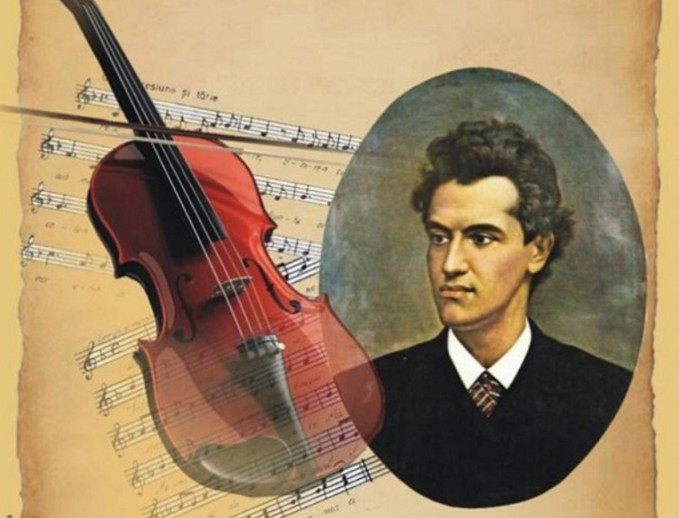
Ciprian Porumbescu was born on October 14, 1853, in the village of Șipotele Sucevei, in Bukovina. At an early age, he began studying music under the guidance of Carol Miculi, a disciple of Frédéric Chopin.
He was a very talented and sensitive child, showing exceptional precocity, especially in music. He later attended the Higher Gymnasium in Suceava, where he deepened his systematic study of piano, violin and organ. Although he enrolled at the Theological Seminary in Chernivtsi, music remained his great passion, and he continued studying piano and violin, as well as cello.
His first composition was the lied “A Desire”, with lyrics by Matilda Cugler. His life was intensely active, marked by public concerts, the organization of vocal ensembles, rehearsals and nighttime study, when he copied scores for choirs and orchestras. He composed with remarkable intensity, despite his already fragile health. At the same time, he became involved in political and national activities and served as president of the Romanian student society Arboroasa.
His compositions from this period had a strong patriotic character. In 1877, he was arrested by the Austrian authorities because of his involvement in Arboroasa. He spent almost three months in detention, an experience that further weakened his health. After being acquitted, he went to Vienna to continue his musical studies. Among his teachers was Anton Bruckner.
After completing his studies, he settled in Brașov, where he worked as a music teacher and conductor of the Romanian church choir.
Although his health continued to deteriorate, he composed with increasing intensity. In 1880, he published a “Collection of Social Songs” for Romanian students, containing 20 choral pieces, including “Cântecul gintei latine” (“Song of the Latin Race”), “Cântecul Tricolorului” (“Song of the Tricolour”) and “Pe-al nostru steag e scris Unire” (“On Our Flag Is Written Unity”).
Among his best-known works is the “Ballad for Violin and Orchestra”, which has become one of the most widely recognized Romanian instrumental compositions. His output also included “Hora”, numerous Romanian songs and religious music. In 1882, his operetta “Crai Nou”, based on a libretto by Vasile Alecsandri, was premiered in Brașov with great success.
A new misfortune came to overshadow his life in the form of a tragic love story. Porumbescu fell in love with Berta Gorgon, but the two could not marry because of opposition from their families. Their different religious backgrounds were among the obstacles, while Berta’s father also opposed Ciprian’s involvement in the Romanian national movement.
In November 1882, Porumbescu travelled to Nervi, Italy, hoping that the climate would help improve his health. His condition, however, continued to deteriorate, and he returned to Romania in 1883, longing for his home and family.
On June 6, 1883, Ciprian Porumbescu died at Stupca, at only 29 years of age.
Thus died a genius whose life was tragically short, but whose music became an enduring part of Romania’s cultural heritage.





 International editions: