


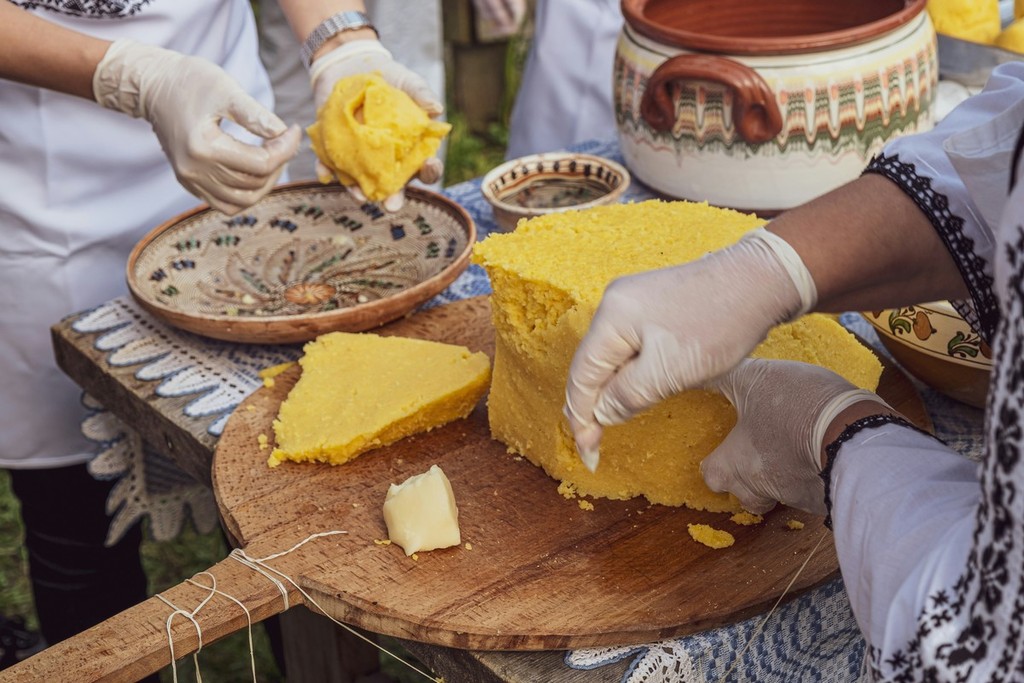
Simple, filling and easy to prepare, it has become a staple of Romanian cuisine and an important part of the country’s culinary heritage. But although mămăligă is now regarded as a traditional Romanian dish, its story began much farther away.
The ingredient that would ultimately transform the history of mămăligă was corn, a plant native to the Americas. Corn arrived in Europe following Christopher Columbus’s voyages and was first introduced to Spain, from where it gradually spread to other parts of the continent. In Italy, for example, corn was already known by the beginning of the 16th century. Its spread throughout Europe, however, was a gradual process.
This means that the mămăligă made from cornmeal that we know today could not have existed in Europe before the arrival of corn.
Long before corn reached the continent, however, people were already preparing similar dishes: thick porridges made from ground grains such as millet and other cereals. The idea of cooking ground grains with water is therefore much older than cornmeal mămăligă itself.
Corn proved particularly well suited to this type of preparation. As its cultivation spread, cornmeal became an important food in rural communities. Corn could be ground and turned into a simple, affordable and filling dish that could easily become part of everyday meals.
In Romania, corn gradually came to play an important role in both agriculture and rural food culture. Traditional households stored corn in structures specifically designed for this purpose, while mills and other grinding facilities became part of village life and the rural economy. The Dimitrie Gusti National Village Museum in Bucharest preserves numerous examples of traditional households and installations that illustrate the importance of corn in Romanian village life.
This is where mămăligă began to establish itself as an emblematic part of Romanian cuisine. Made with cornmeal, water and salt, the basic recipe was simple and required only a few ingredients. Mămăligă could be served with cheese, milk, sour cream, stews, fish or other traditional dishes, with recipes and combinations varying from one region to another.
Interestingly, mămăligă is not unique to Romania. Similar cornmeal-based dishes developed in several parts of Europe after corn became widespread. In Italy, for example, polenta became an important part of the country’s traditional cuisine.
Romania, therefore, is not the historical birthplace of cornmeal itself, nor is mămăligă an exclusively Romanian type of food. What makes it particularly Romanian is the way the dish was adopted, prepared and incorporated into everyday life and traditional cuisine.
Today, mămăligă can be found both in traditional Romanian cooking and on the menus of restaurants that reinterpret local dishes. From the classic combination of mămăligă with cheese and sour cream to dishes served alongside sarmale, fish or hearty stews, it has made the journey from the traditional rural table to contemporary cuisine without losing its identity.
Perhaps that is what makes the story of mămăligă so fascinating. It was not a dish invented in Romania, but it became deeply rooted in Romanian culture through centuries of use, adaptation and tradition.
A dish with distant origins, an ingredient that crossed the Atlantic, and a history shaped in Romanian households: mămăligă is a fascinating example of how food evolves when plants, cultures and culinary traditions travel from one part of the world to another.




 International editions: