


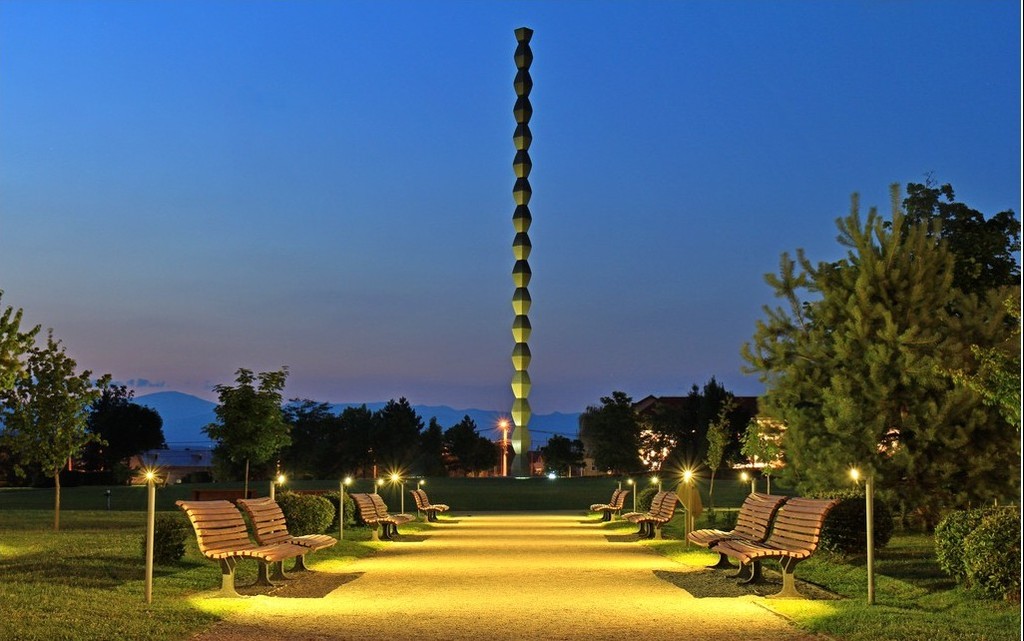
More than a monument, it is a universal symbol of spiritual ascent, sacrifice, continuity, and the human aspiration toward infinity. Located in the city of Târgu Jiu, the sculpture is part of the celebrated monumental ensemble created by Brâncuși between 1937 and 1938 in honor of the Romanian heroes who died during World War I.
Brâncuși spent more than four decades refining the concept that would eventually become The Endless Column. His artistic research focused on discovering the perfect balance between form, rhythm, proportion, and perspective. The sculptor gradually transformed a simple geometric module into one of the most recognizable artistic symbols of the twentieth century.
The earliest version of the column appeared in 1926 during an exhibition held in the Tuileries Gardens in Paris, where Brâncuși presented a work composed of two rhomboidal modules under the title Endless Column. That same year, the artist experienced a decisive moment when photographer Edward Steichen installed one of Brâncuși’s columns in the garden of his estate in Voulangis, France.
For the first time, the sculpture was displayed outdoors as an independent monumental work. Rising approximately seven meters high and composed of nine complete modules and two half modules, the column stood solemnly in the landscape, demonstrating the extraordinary dialogue Brâncuși envisioned between sculpture, nature, and open space. Although the work was later dismantled when Steichen returned to the United States, the experience deeply influenced Brâncuși and strengthened his ambition to create a monumental version on a much larger scale.
That dream became reality a decade later. In 1937, Brâncuși received the commission to create a monument dedicated to the Romanian soldiers who fell defending the Jiu Valley during World War I. The artist accepted the project with profound emotion, seeing it as an opportunity to leave a spiritual legacy for the Romanian people.
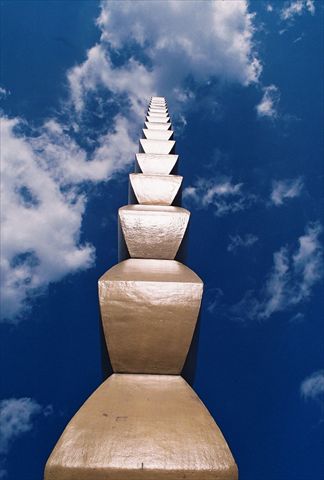
Constructed in 1937–1938, The Endless Column in Târgu Jiu reaches nearly 30 meters in height and consists of fifteen complete rhomboidal modules together with two half modules. The structure was realized with the technical support of engineer Ștefan Georgescu-Gorjan, a close collaborator and the son of one of Brâncuși’s childhood friends. The metal structure was built around a steel core, while the exterior was covered with cast iron modules treated with a brass finish, giving the monument its luminous golden appearance.
Brâncuși personally supervised many stages of the construction process and documented the development of the work through photographs and notes, carefully preserving an archive dedicated to the creation of the monument.
Encouraged by the enthusiasm surrounding the project, Brâncuși expanded his vision into a complete monumental ensemble that also included The Gate of the Kiss and The Table of Silence. Together, these three masterpieces form the famous Calea Eroilor (“Heroes’ Path”), a symbolic route dedicated to memory, sacrifice, meditation, and spiritual elevation.
The ensemble was conceived as an initiatory journey. The visitor moves from the Table of Silence — a place of reflection and contemplation — through the Gate of the Kiss, symbolizing transition and human connection, and finally toward the Endless Column, which rises toward the sky as a symbol of transcendence and infinite continuity. The avenue connecting these monuments creates one of the most remarkable urban artistic compositions in Europe.
The location of the column itself was carefully chosen. Installed in an open landscape on the outskirts of Târgu Jiu, the monument appears to emerge naturally from the earth while extending endlessly upward. Through its repeating geometry and vertical rhythm, the sculpture creates the illusion of infinite expansion beyond physical limits.
Although Brâncuși remained deeply attached to the project, there is no definitive historical evidence confirming his presence at the official inauguration of the ensemble. Historians believe the tense political climate in Europe on the eve of the Second World War may have influenced his absence.
Brâncuși continued to dream of even larger monumental projects. During a visit to Chicago in 1939, he discussed the idea of building a gigantic version of the Endless Column on the shores of Lake Michigan. The proposed structure would have exceeded 400 meters in height, surpassing both the Washington Monument and the Empire State Building at that time. Conceived as a habitable architectural structure clad in reflective metal, the project was envisioned as a symbol of humanity and universal continuity. Despite support from several intellectuals and architects, the ambitious project was never realized.
Today, the Endless Column is recognized internationally as one of the defining achievements of modern art and a masterpiece of abstract sculpture. The monumental ensemble of Târgu Jiu continues to attract visitors, researchers, artists, and architects from around the world, remaining an essential landmark of Romanian cultural heritage.
Beyond its artistic innovation, the Endless Column has inspired countless philosophical and spiritual interpretations. Some critics associate it with ancient cosmological symbols, while others identify influences from Romanian folk art or Eastern philosophy. Yet Brâncuși himself consistently pursued simplicity, purity of form, and essential meaning rather than complex theoretical explanations.
Ultimately, the Endless Column represents far more than a repeating geometric structure. It is a visual expression of freedom, hope, continuity, and the eternal human desire to transcend earthly limitations. Rising endlessly toward the sky, Brâncuși’s masterpiece remains a timeless meditation on humanity, memory, and the infinite.




 International editions: